Assessing the US Landscape Post-DISA Uranium Deal; Brownfield Projects Preferred

DISCLAIMER: Any written content contained herein should be viewed strictly as analysis & opinion and not in any way as investment advice. Visitors to this site are encouraged to conduct their own due diligence. As a Research Spotlight product, HoldCo Markets has received financial compensation for the written content and analysis below. Please read the full disclaimer here: holdcomarkets.com/disclaimer
Earlier last week, IsoEnergy (ISO) announced a landmark definitive agreement with DISA Technologies to form DISA Uranium Corp. With IsoEnergy contributing its Utah uranium portfolio, DISA Uranium will be able to combine a portfolio of permitted, past producing conventional uranium assets with its proprietary High-Pressure Slurry Ablation (HPSA) processing technology and remediation/recovery business.
Factoring in the concurrent $105M private placement financing, DISA Uranium’s implied pro forma fully diluted equity value would be approximately $505M. Provided the successful application of DISA’s HPSA processing technology may unlock a large, untapped uranium resource through remediation and recovery, laying the foundation for new domestic processing infrastructure. The deal id backed by a syndicate of strategic investors including BHP Ventures, Galvanize Climate and Valor Equity Partners. The transaction and financing are expected to close later in August. IsoEnergy will own approximately 33% of the company's issued and outstanding shares on a fully diluted basis and will be DISA Uranium's single largest shareholder. Ultimately, it is our view that this type of transaction validates much of what has been our focused, LT investment thesis – the preference for quality brownfield projects with historic work and/or uranium production over much more speculative greenfield projects. Our three preferred brownfield projects are outlined further below.
DISA URANIUM: BUILDING A LEADING US CONVENTIONAL MINING & RECOVERY PLATFORM
Earlier last week, IsoEnergy (ISO, price objective C$18 per share) announced a landmark definitive agreement with DISA Technologies to form DISA Uranium Corp. With IsoEnergy contributing its Utah uranium portfolio, DISA Uranium will be able to combine a portfolio of permitted, past producing conventional uranium assets with its proprietary High-Pressure Slurry Ablation (HPSA) processing technology and remediation/recovery business. In addition to a concurrent $105M financing, DISA will be positioning itself to be an integrated domestic uranium platform boasting both proprietary processing capabilities and a portfolio of uranium assets located in Utah. The assets being contributed from IsoEnergy include the Tony M Mine, the Daneros Mine, the Rim Mine, the Sage Plain Project and the Flatiron Project – all of which are permitted and past producing assets.
Founded in 2018 and based out of Wyoming, DISA Technologies is a company that offers solutions to enhance recovery and transform waste material into productive assets across mining and remediation. The company specializes in clean resource recovery and legacy mine remediation using a patented High-Pressure Slurry Ablation (HPSA) processing technology. The core technology uses high pressure slurry jets to selectively fracture and liberate critical minerals from ore or waste, without needing the more traditional methods involving grinding or harsh chemicals. HPSA technology is a scalable and modular platform which can be integrated into multiple points in the processing flowsheet. When applied, HPSA has been proven to extract additional value from lower grade ore in a faster, cleaner and more efficient way. When applied, HPSA has the potential to significantly reduce operating costs by upgrading mineralized feedstock and by reducing waste volumes. This technology has been applied to various minerals including copper, zinc, potash, rare earths, precious metals, nickel and of course, uranium.

Last September, the Nuclear Regulatory Commission (NRC) approved a license application submitted by DISA to use HPSA technology for remediating abandoned uranium mine waste at inactive mining sites. Testing at IsoEnergy’s Tony M Mine validated the HPSA benefits – a leach study conducted earlier this year found the following:
A 4.0x uranium grade uplift (going from 3,500ppm to 14,087 ppm).
Ability to reduce feedstock mass to 22% of its original volume.
88% Uranium recovery.
2 hours of leach time post-HPSA process (versus conventional methods at 20+ hours).
The NRC license approval and ultimately the leach test conducted at the Tony M mine set the stage for the announced definitive agreement announced last week with IsoEnergy.
A STRATEGIC SYNDICATE OF INVESTORS BACKING THE DEAL
Pursuant to the definitive agreement, in exchange for contributing the Utah uranium portfolio to DISA Uranium, IsoEnergy will receive 1.677M shares of common stock of the company. A concurrent private placement for $105M was announced supported by strategic mining and technology investors including BHP Ventures, Galvanize Climate Solutions, Valor Equity Partners, Evok Innovations, Halliburton Labs, Veriten and Tembo Capital. IsoEnergy has agreed to participate in the financing in the amount of $33M. Expected to close later in August, the proceeds from the financing are anticipated to be used to advance DISA Uranium’s conventional mine development, fund remediation and recovery programs, progress domestic uranium milling infrastructure, and support the company’s long-term growth. Factoring in the private placement financing, DISA Uranium’s implied pro forma fully diluted equity value would be approximately $505M. This would rank DISA Uranium as one of the leading US-based conventional uranium platforms.
CONCLUSION: A PREFERENCE FOR BROWNFIELD PROJECTS OVER GREENFIELD PROJECTS
Applying the HPSA technology to conventional past-producing conventional uranium deposits can prove to be the game changer needed to further accelerate investments in United States uranium projects and the related supply chains. Driven by AI-powered electricity demand and United States energy security priorities, DISA is well positioned to unlock a large untapped domestic uranium resource. Following the successful leach testing at Tony M, much larger things can now be expected given full portfolio ownership of quality, past producing uranium assets in Utah.
By leveraging decades worth of historical work (including drill programs, mapping, geophysics, previous permitting and/or production), our view has always been that provided good project data and mineralization, a brownfield project opportunity will always provide a better risk-adjusted return when compared to a much riskier greenfield opportunity. The announced transaction with DISA and IsoEnergy validates our investment thesis, as does the impressive investor syndicate participating in the private placement.
According to DISA, HPSA technology can be used to remediate the estimated 15,000 abandoned/mothballed uranium mines scattered throughout the western United States. Our favored uranium brownfield projects which should garner more attention on back of the DISA transaction include:
Terra Clean Energy’s Marysvale Project (Utah) – Price objective C$0.22 per share.
Myriad Uranium’s Copper Mountain Project (Wyoming) – Price objective C$0.87 per share.
North Shore Uranium’s Rio Puerco Project (New Mexico) – Not rated.
Much like the Utah portfolio involved in the DISA Uranium definitive agreement, the respective flagship uranium projects from the three companies listed above also each come with an extensive historical database of drilling and past (or very near) historic uranium production.
TERRA CLEAN ENERGY CORP (TCEC): PLENTY OF DATA & HISTORIC PRODUCTION AT MARYSVALE
Over the last 12 months, Terra management has been active in re-shaping the company by spearheading a concerted effort to add strategic U.S. uranium projects in order to diversify from being solely an Athabasca Basin focused uranium company. With successful staking/acquisitions in Wyoming and two recent Utah earn-in agreements finalized, given the compelling re-focus of the company, we highlight the rapid development work conducted since on the wholly-owned Marysvale Uranium Mines Project, located just 115 miles from the soon-to-be DISA Uranium’s Tony M Mine in Utah.

Since announcing the earn-in agreement for the Marysvale Uranium Mines Project this past January, Terra management has been focused on compiling historic data, initiating various work programs and pushing ahead with permitting in a very timely manner. Ahead of a highly anticipated drilling campaign, the publication of a NI43-101 compliant Technical Report (effective date of May 31, 2026) is the culmination of these efforts. That said, combined with the use of modern exploration techniques and 3D modeling, management will use the historic data gathered (drill results, geochemical results and sampling) to fine tune targets in the priority zones now identified on the property. Of note is that recently procured drill logs, geochemistry data, geologic data and maps will serve to further refine the summer drill targets.
The completed Technical Report represents a significant milestone in Terra’s systematic evaluation of the Marysvale Uranium Mines Project and provides a comprehensive review of the property’s geology, historical mining activities, exploration results, and future exploration potential. The Technical Report incorporates the company’s recently completed data compilation program, digitization of historical records, and interpretation of geological and structural information collected from the project area. This has been quick work seeing that the Project was acquired earlier this year. The Marysvale Uranium Mines Project includes several past-producing uranium mines within one of the most historically productive uranium districts in the western United States.
As announced earlier this week, Terra managed to successfully complete the digitization and compilation of an extensive historical database for the Marysvale Project. The newly acquired historical database includes thousands of feet of drill logs, underground geological mapping, production records, assay certificates, geochemical data, mine plans, level maps, cross-sections and technical reports generated by previous operators, including work completed by Anaconda and other historical mining companies active in the district. The company has now digitized and integrated these datasets into a comprehensive three-dimensional geological model utilizing modern exploration software.
Permitting Underway, Drilling Expected to Commence Later this Summer
Recall that in May, Terra announced that following an extensive surveying program involving airborne radiometric and photogrammetric surveys, numerous high priority zones have been identified at the Marysvale Uranium Mines Project. Spanning 101 grid line-kms flown using 20m line spacing, the integrated airborne survey program was completed across the company’s newly expanded land package and has successfully identified several high-priority exploration zones exhibiting characteristics consistent with structurally controlled vein-style uranium mineralization. The integrated airborne survey program was completed across the company’s newly expanded land package and was successful in identifying several high-priority exploration zones exhibiting characteristics consistent with structurally controlled vein-style uranium mineralization. The survey was conducted by Land Survey Advisors of Heber City, Utah. The radiometric survey outlined numerous discrete uranium anomalies associated with favorable host lithologies and established regional mineralized trends. These anomalies are interpreted as potential near-surface uranium-bearing zones and represent compelling follow up targets for the Company’s upcoming field program.
Permitting remains active with the U.S. BLM and the Utah Division of Oil, Gas and Mining. Provided receipt of the necessary permits (expected shortly) and given current crew and consultant availability, management expects to begin the ~10,000 ft drilling campaign later this summer. Ahead of the drilling campaign, the summer exploration program has involved:
Ground-truthing of airborne anomalies
Detailed geological mapping
Geochemical sampling
Structural interpretation and target refinement
Advancement of priority drill targets
The Marysvale Uranium Mines Project
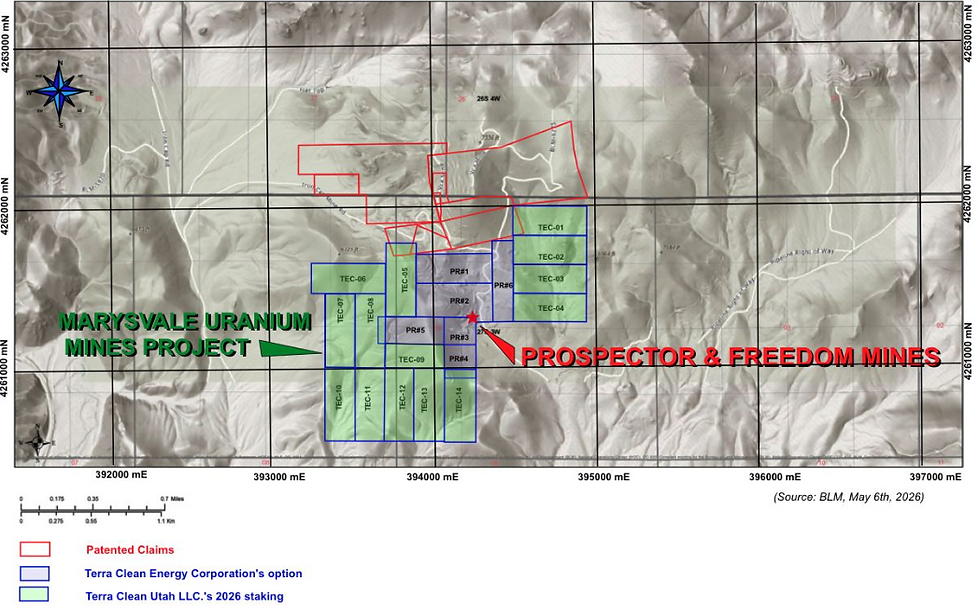
Terra’s 20 claims cover four past producing uranium mines (the Prospector 1 Mine, the Prospector 4 Mine, the Buddy Mine and the Lucky Strike Mine). Collectively, the Marysvale district produced over 1.33M lbs at a reported grade of 0.22% U3O8. It is estimated that 75% of that historic production (~1.0M lbs U3O8) came from the Prospector and Freedom mines, part of Terra’s Marysvale package. The Marysvale District hosts nearly vertical, northeast and east striking fissure veins that cut granitic and volcanic rocks of the Belknap volcanic sequence and is a prime example of an epithermal vein-style uranium system. Ore is located within the north-northwesterly striking, near vertical, Prospector Fault. Uranium in the area was discovered in 1948 and mining commenced in 1949 by Vanadium Corporation of America (VCA). Over the next few years they consolidated various claims and operations in the area. Production ceased in the Marysvale area in 1969. Some exploration drilling was undertaken in the area in the late 1970’s.
A Technical Report authored by the US Department of the Interior Geological Survey dated September 1950 specified that inclined shafts were sunk on the Prospector 1 and Freedom 2 claims. The first ore mined was trucked to Naturita, Colorado, for experimental processing. Subsequent ore was stockpiled near the mines with much being purchased by the American Smelting and Refining Company under the authority of the Atomic Energy Commission.
Recapping Our Investment Thesis
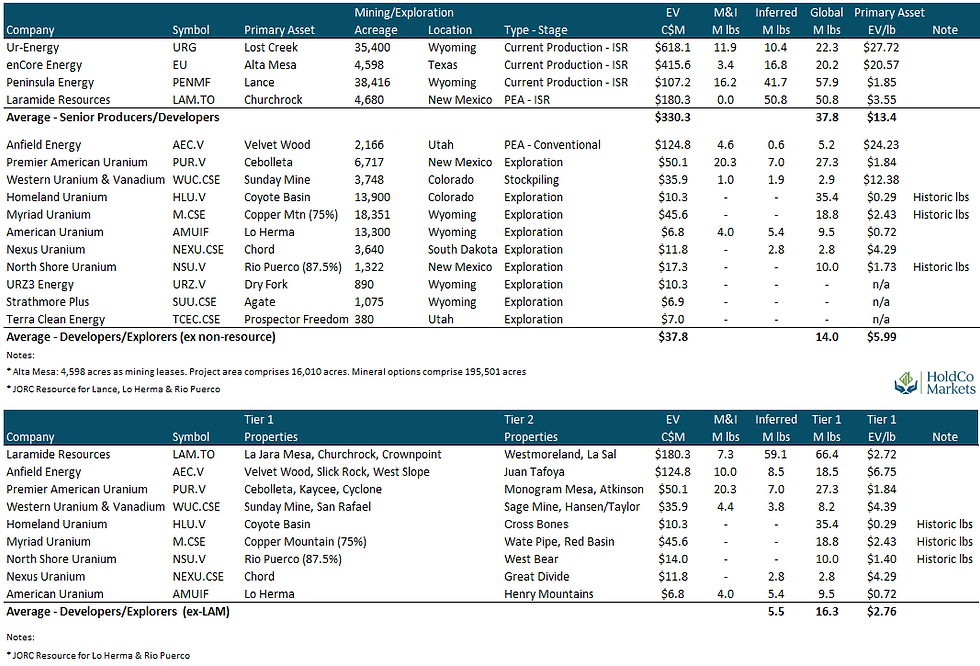
On an EV basis, Terra currently trades at a ~60% discount to its U.S.-focused, pre-resource peer group. We feel that this is currently justified given the constraints weighing on the company such as company size and liquidity. Moreover, the new direction positioned towards Utah and Wyoming coupled with the very modest and attainable earn-in conditions remain largely unknown to the market. It is our view that this dynamic will change as the new assets will slowly de-risk as development ramps and milestones are made.
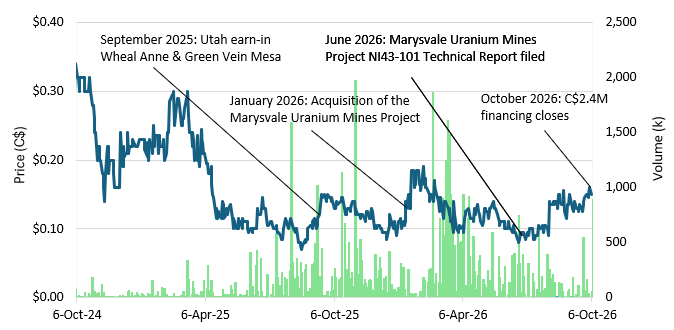
Earn-In Agreements Signed for Utah Uranium Properties – Earlier in January Terra announced plans to earn a 100% interest in the past producing Freedom & Prospector Mines Project, located in Marysvale Utah. This announcement follows the September 2025 announcement that an earn-in framework was negotiated for a 100% interest in past producing uranium claims (the Wheel Anne claims and the Green Vein Mesa claims) located in Emery County, Utah.
Historic Production, Strategic Location – The Utah claim areas include a number of historic mines which collectively produced approximately 1.45M lbs uranium between 1949-1969. Both Utah claim areas are well situated within 300km of either the White Mesa mill or the Shootaring Canyon mill.
Successful Staking in Wyoming – Given low cost staking and lease acquisitions, a sizeable 3,395 acres were obtained in Wyoming. Located in the Washakie Basin, the property package is situated just 75km from historic uranium production in the Poison Basin and 120km from enCore Energy’s PEA-level Juniper Ridge Uranium project.
This is the New Terra Clean Energy Corp. – Though the uranium portfolio continues to contain the 6.8M lb deposit in the Athabasca Basin (South Falcon East), the recent US acquisitions fundamentally change the profile of the company. In our view, the new claim areas and the corresponding capital outlays which we deem as modest and achievable, greatly enhance the profile and future prospects of the company.
CONCLUSION & VALUATION
Though Terra’s uranium portfolio continues to be anchored by the 6.8M lb South Falcon East deposit (Athabasca Basin), the recent U.S. acquisitions have fundamentally changed the profile of the company. Since last Fall, Terra management was successful with identifying strategic uranium properties and then either staking or negotiating earn-in agreements at what we deem as a modest capital outlay with meaningful ownership milestones. The claims on past producing properties in Utah include valuable historic data compiled by the U.S. Geological Survey (among others). Combined with the use of modern exploration techniques and 3D modeling, management will use the historic data to identify priority targets for confirmation drilling in identified zones and exploration drilling to test for extensions. The completion of a NI43-101 compliant Technical Report is a culmination of all the efforts conducted thus far. Of note is that recently procured data from both Anaconda Energy and Vanadium Corporation of America (encompassing drill logs, geochemistry data, geologic data and maps) will serve to further refine the summer drill targets. Owing to timing, this newly received data did not make the cut for inclusion in the Technical Report.


Given a revamped management team, a newly re-constituted Board and Terra’s recent initiatives into Utah and Wyoming, much new interest has been re-injected into the company. We note that the average trading volume YTD has nearly tripled the average daily figure from 2025. Ultimately, we look forward to the start of the high impact drilling program at the Marysvale Project. Underpinned by our $4.75 per lb in-situ valuation for 51% ownership of South Falcon East, our 0.60x NAV multiple leads to our C$0.22 per share price objective. This implies upside of +57% from the recent close (August 12). For additional asset-specific information refer to our research report dated February 19, 2026. Our most recent report, dated June 10 can be found here.
MYRIAD URANIUM (M): IS COPPER MOUNTAIN THE NEXT LARGE SCALE US URANIUM DEPOSIT ?
As started earlier last month, Myriad’s Phase 2 drilling program at the Copper Mountain Uranium Project (Wyoming) is in full swing with a total of 4,500m of drilling planned for over two stages. Stage 1 of the current drilling campaign will test areas of mineralization underlying the historical estimates. A total of ~2,250m is expected to include drill holes on the Lucky Cliff, Arrowhead, Mint, Hesitation and Gem targets. A further ~2,250m will be earmarked for Stage 2 step-out drilling on priority targets previously identified by the Union Pacific and Bendix technical studies. Certain new targets which were not part of any historic resource estimate or any historic resource exploration target will also be drilled as part of stage 2. Contingent on positive stage 1 and 2 drilling, a final stage 3 drilling campaign will be undertaken. This final stage 3 is expected to encompass between 2,400m-5,500m of infill drilling to support a maiden mineral resource estimate by bringing some of the historic resource into current categories.

Following a maiden drill program which concluded in late 2024 (the first of any such drilling campaign conducted at Copper Mountain since 1979), Myriad management remains busy in the midst of Phase 2 drilling and in the midst of completing a 100% consolidation of the Copper Mountain Project (a Rush shareholder vote is scheduled for August 17). Building upon an extensive database comprising of over 2,000 boreholes and encompassing a combined ~900,000+ feet of historic drilling, Myriad is in the midst of its confirmation/exploration drilling program with the intent to bring the historic Copper Mountain resource to current-day NI43-101 compliance. Studies conducted between the late 1970s-early 1980s have estimated the resource to be between 15.7M-30.1M lbs U3O8. Other estimates have suggested resource potential upwards of several hundred million lbs U3O8. Since a maiden drill program was conducted in 2024, Myriad has much riding on the current Phase 2 program. We expect the Project to continue to de-risk while an eventual NI43-101 compliant resource may have the potential to officially rank Copper Mountain as one of the larger uranium deposits located in the United States.
Large Historic Resource at Copper Mountain
Rocky Mountain Energy Corporation (RMEC) estimated Copper Mountain’s resource estimate potential to be as high as 63.8M lbs when factoring in “just” 2 of the 5 identified deposits (Canning and Fuller). At a 0.01% eU3O8 grade cut-off, the resource estimate from the Canning pit alone was estimated to be 21.1M lbs U3O8. In 1980, Fluor followed-up with a study of its own (commissioned by RMEC) in what was considered to be a much more conservative estimate due to the methodology used - conditional lognormal probability distributions. Using the chosen conditional probability, Fluor applied a delayed fission neutron (DFN) adjustment which reduced the grades. Ultimately, an estimate of 14.6M lbs was calculated for Canning and parts of four other surrounding deposits (Fuller, Mint, Allard and Hesitation). Using both the RMEC and Fluor data, further studies were conducted with Gregory Liller authoring a resource estimate in 1991 and A.C.A Howe International Ltd (authored by Bojan Zabev) completing its own resource estimate in 1997. Incorporating the Canning deposit along with portions of 6 other deposits (Fuller, Mine, Allard, Hesitation, Arrowhead and Gem) these two latest reports were summarized as seeing the total resource between 15.7M lbs-30.1M lbs U3O8. For additional details, refer to our initiation of coverage report, dated August 8, 2025.

Recapping Our Investment Thesis
What gives Myriad a big head start with regards to developing Copper Mountain is the substantial project de risking already achieved by way of its historic drilling program. This historic drilling program (conducted in the late 1970s) provided a vast array of technical data which lead to numerous technical reports and various resource estimates derived from different methodologies. In short, the substantial historic work conducted on the Copper Mountain Project has amounted to: A) C$117M in historic exploration spent (2024 dollars), B) 2,000+ historic boreholes drilled on the property (totaling ~900,000+ ft), C) A total of 7 deposits discovered and D) Numerous technical reports & resource estimates. In addition to the historic work completed on site, other company positives include:
Location: Wyoming is known to host the large uranium reserves in the United States. The state’s tier-1 uranium status is also accentuated by the fact that nearly a dozen uranium operations are currently licensed. Moreover, uranium mining is currently being conducted at four separate facilities: Ross CPP, Smith-Ranch highland, Nichols Ranch and Lost Creek. Lastly, Wyoming is home to one of the largest uranium mills in the US – currently on standby, the Sweetwater mill has a capacity for 3,000 tpd.
Recent Drill Program Success: Myriad’s Phase 1 drill program returned better than expected grades when using spectral gamma detection. From the assay results received thus far, uranium grades have been 20%-60% higher than the initial gamma probe readings. Additionally, strong grades were detected at depth- this provides for the potential to find deeper target zones.
Copper Mountain Ownership & Land Consolidation Fast-Tracked: Myriad exercised its initial 50% option on Copper Mountain by way of meeting the necessary qualifying spend in October 2024. By the end of 2025, 75% of the Project was owned. Given the Rush shareholder vote next week, we would expect 100% consolidation to be finalized in the next weeks ahead.
CONCLUSION & VALUATION
Seeing as the Phase 1 assay results have largely surpassed grades as estimated from gamma probe testing, the potential to confirm the historic resource is apparent, but so is the potential to expand and grow the resource as well. For this reason results from the current Phase 2 drilling program will be very impactful. We look forward to the successful consolidation of the Project and for initial assay results from the Phase 2 drilling program. Pending positive drilling success, the risk remains on the upside for a continued valuation re-rate higher.


Using the historic resource as a weighted benchmark, we continue to apply our $3.25 per lb in-situ valuation along with a target NAV multiple of 0.60x. We maintain our in-situ based price objective (12 months) of C$0.87 per share, this equates to potential upside of +93% from the most recent close on August 12. Our most recent note dated July 3rd, 2026 can be found here.
NORTH SHORE URANIUM (NSU): POINTING THE SPOTLIGHT ON RIO PUERCO – NOT RATED
Located in the Grants Uranium district in New Mexico, the Rio Puerco Project contains much of what we like to see in a brownfield uranium project – A large property package (83 BLM claims) with extensive historic drilling (over 1,100 exploration holes drilled by the Kerr-McGee Corporation). Armed with extensive data sets and the aforementioned drilling, in the 1970s, Kerr-McGee began development for an underground mine. A victim of low uranium prices in the early 1980s, after a brief trial mining phase, development activities ground to a halt. In the years since, ownership of the Project has changed multiple times however development wasn’t entirely abandoned. A historical JORC resource of 6.0M tonnes at an average grade of 0.09% eU3O8 for 11.4M lbs U3O8 was estimated in 2009 and again in 2011.
The Rio Puerco Project in New Mexico is located at the eastern end of the Grants Uranium District, the largest historic producer of uranium in the United States. Mines that operated there between 1950 and 2002 produced over 340M lbs U3O8. The district is currently seeing renewed exploration and development activity. The Project is located within ~60km of other established uranium projects such as Energy Fuels’ (UUUU) Roca Honda (17.6M lbs M&I, 13.8M lbs Inferred), enCore Energy’s (EU) Marquez-Juan Tafoya (18.1M lbs Inferred) and Premier American Uranium’s (PUR) Cebolleta (20.3M lbs Indicated, 7.0M lbs Inferred).

Phase 1 Rio Puerco Drilling Now Completed
North Shore Uranium announced the start of its Phase 1 drill program this past June. The intent of the program was to validate the historic resource while also expanding the uranium mineralization footprint. As announced earlier today, the Phase 1 program has been completed with 2,828m of rotary hole drilling spread over 13 holes.
At each of the 13 sites, a 14.6cm (5.75 inch) vertical mud rotary hole was drilled by Harris Exploration Drilling and Associates. Samples collected at 1.5m intervals were logged by a supervising geologist for lithology, colour and texture, and scintillometer readings were taken to measure radioactivity. Select samples were submitted for assay and representative samples were retained in chip trays for future reference. North Shore is now analyzing the results from the Phase 1 program and intends to return to the Project in Q4/2026 for Phase 2 of the drill program, after the summer monsoon season. Recall that the company is currently permitted to drill up to 26 holes encompassing 5,975m.

EXHIBIT 1 – PEER VALUATION