Domestic Metals Corp: Catalysts Ahead as Drilling at Smart Creek Set to Begin

DISCLAIMER: Any written content contained herein should be viewed strictly as analysis & opinion and not in any way as investment advice. Visitors to this site are encouraged to conduct their own due diligence. As a Research Spotlight product, HoldCo Markets has received financial compensation for the written content and analysis below. Please read the full disclaimer here: holdcomarkets.com/disclaimer
On the cusp of a high impact drilling program expected to commence in August, we provide an overview of the Smart Creek Copper Copper Project, located in Montana. Recall that Domestic Metals Corp (DMCU) current drilling plans are underpinned by the ownership of a treasure trove of historic drilling data. Combining the historic data with recently completed geophysics and mapping surveys, management hopes to vector towards the center of the copper porphyry which might yield assay results surpassing the impressive 109m grading 0.75% Cu that Rio Tinto attained on site in 2022. Though several delays related to securing a drilling crew and permit processing by the US Forest Service, we expect the fully financed drilling campaign to commence shortly. Noting the highly prospective nature of the Project, we maintain our C$0.75 per share price 12-month price objective.

Spanning a very large 12km by 10km area, the Smart Creek Project has benefitted from numerous historic drilling and work programs, culminating today with a total of 40 drill holes on site. With every subsequent work program, a combination of geophysics, sampling, mapping and drilling has lead to the identification of four distinct target zones and increasingly higher grade assay results, extending over longer intervals. This culminated in 2022 when Rio Tinto drilled its standout SMCR0022 drill hole which returned 109m at 0.75% Cu, including 81m at 0.96% cu and 17m at 2.25% Cu. The Domestic Minerals team has since conducted an aggressive geophysics, mapping and sampling campaign and has identified between 3-4 strategic drilling targets contained in all four target zones on the Project. With sufficient capital in treasury, the planned 9,000m drilling campaign is expected to begin shortly. The targets remain varied as the Project is indicating the potential for a large porphyry deposit, a carbonate replacement deposit (CRD)/Skarn deposit, copper leach targets and epithermal gold targets. Combining the historic drilling results with the recently completed geophysics and mapping surveys, management is confident that the selected drilling targets will be vectoring much closer the center of a porphyry or a high-grade zone. If this were to be hit, a company-making assay result surpassing that from SMCR0022 will likely be achieved. One can speculate that if successful, an intercept upwards of 150m grading 1.5% Cu wouldn’t sound unrealistic. Domestic Metals certainly has the experienced technical team to test this theory.
THE SMART CREEK PROJECT
Located 100km southeast of Missoula, Montana, the Smart Creek Project was acquired in August 2024 and is an earn-in joint-venture with Rio Tinto, whereby Rio will retain a 40% stake in the asset. Located in Granite County, the Smart Creek Project is considered to be highly prospective for porphyry copper as well as copper-gold-silver enriched carbonate replacement deposits (CRD). The Project consists of 570 unpatented federal mining claims (4,072 Ha) and 45 patented claims (312 Ha). The property is located approximately 16km north of Philipsburg, Montana and is road accessible year-round.
On the Project, porphyry-related copper, gold, silver and molybdenum mineralization is hosted in sedimentary rocks of the Proterozoic Belt Supergroup and includes the reactive Helena Formation (argillaceous carbonate sedimentary rocks), the main host to mineralization at the Property. The Helena Formation contains significant mineralization, including copper-gold-silver-lead-zinc replacement style mineralization and porphyry copper-gold-molybdenum mineralization. Spread across the entire 12km by 10km Project area, four high priority targets have been identified: the “Smart Creek” porphyry target, the “Smart Creek Exotic Cu” target situated directly to the south, the “Sunrise Mine” replacement target and finally the “Radio Tower” target (Exhibit 3).
At the Smart Creek target, porphyry related alteration and mineralization as evidenced by surface showings (adits, pits and shafts) and surface geochemistry, define an anomalous footprint measuring 5km by 3km. The past producing Sunrise Mine target consists of replacement style lenses of high-grade copper, gold and silver that have potential for expansion through exploration drilling with potential for an associated porphyry “root zone”. The Sunrise target has an anomalous footprint defined by surface alteration, surface mineralization and surface geochemistry measuring 3km by 2km. Additional exploration opportunities were recognized on the Smart Creek Project with the potential for carbonate replacement style mineralization (CRD) at the Smart Creek target. Elsewhere at Sunrise, there are copper, gold and silver replacement bodies near and associated with the historic Sunrise Gold Mine. These indications are evidenced by widespread marbleization and skarn development associated with manganese oxides and copper oxides in the carbonate metasedimentary rocks of the Helena formation. The Smart Creek copper target remains a high-priority target with widespread, high grade copper oxides (and sulphides) which outcrop at surface. Both the Smart Creek and Sunrise Mine targets are drill ready and will feature prominently in the upcoming drill program.

HISTORIC MINING AND DRILLING
Historic mining activity from the Project area included high-grade copper-silver ore (several ‘000 tonnes) taken from the Smart Creek area prior to 1930, placer gold dredging in the late 1800s and early 1900s (northeastern margin of the property), and production of approximately 12,500 gold ounces from thin manto-style beds and fissures averaging 0.2 ounces per tonne gold, 1.0 ounce per tonne silver and 1.5% copper at Sunrise. Placer mining between 1943 and 1947 concentrated on scheelite for the war effort which resulted in approximately 215,000lbs of 63% tungsten trioxide.
Since then, exploration work on the property included drilling in the late 1960s by Bear Creek Mining (5 holes) and Melissa Syndicate (8 holes). These drilling campaigns targeted near surface copper-silver-lead-zinc mineralization in search of sediment-hosted copper at Smart Creek. More recently, between 2010-2012, Smart Creek Resources attempted to drill 2 exploratory holes which did not reach target depth. The United States Bureau of Mines, Exxon, Utah International, Noranda and Pegasus have all conducted exploration drilling programs at the Sunrise historic mine area targeting tungsten, copper and gold. In 2016, Rio Tinto (Kennecott) acquired the property and identified a large zoned geochemical (soil and rock sample geochemistry) footprint consistent with a porphyry copper-gold molybdenum hydrothermal system. Over the course of 2.5 years, Rio drilled 26 of the 40 permitted sites as they vectored towards the center of the porphyry at the Smart Creek target. With a total of 40 historical diamond drill holes and 5 surface trenches available for Smart Creek, the more significant drilling intercepts are summarized below.

From the Smart Creek Exotic Zone, highlight drill hole SMCR0022 (as seen above) returned an interval from surface of nearly 110m at 0.75% Cu, including nearly 81m at 0.97% Cu and nearly 17m at 2.25% Cu. Note that despite the already high assay result attained from SMCR0022, the center of the porphyry has not yet been hit. This particular drill intersection was found to be analogous to the Queen Mine located in Bisbee Arizona (346.6Mt grading 0.656% Cu). With the exception of 8 drill holes drilled in the late 1960s (and 5 surface trenches), the balance of the holes drilled on the property (32 drill holes) were drilled much more recently, between 2017-2022. Rio Tinto drilled highlight hole SMCR0022 in 2022.
2025 SUMMER FIELD PROGRAM
Between August-September 2025 a field sampling and mapping program was conducted on the property. The program focused on geological mapping as well as several novel rock sampling techniques including: prospecting grab/composite grab samples and limestone sampling for trace metal vectoring. Sample subsets were also evaluated for alteration (slab and stain for potassic alteration related to porphyry mineralization), UV light evaluation (seeking metal contaminated calcite veins that can assist with vectoring toward CRD and porphyry mineralization), short-wave infrared evaluation (clay alteration vectoring) and portable XRF evaluation of iron oxide fracture fill (geochemical leakage vectoring technique to identify mineralization). Ultimately, the program was designed to characterize known mineralized zones, refine drill target locations and identify new areas for follow-up exploration. Assay results from the 2025 field sampling program include:

The 2025 field campaign was a success given various assays yielding high grade results for both copper, gold and silver. As seen above, rock sample assays from outcrops, historic trenching, mines and workings demonstrated high-grade gold, copper, silver and zinc. Moreover, the samples combined with the various IP surveys confirmed that the Project is prospective for porphyry copper deposits, carbonate replacement deposits, skarn and exotic copper deposits. As per data obtained from the 310 samples gathered from program, 39 samples exceed grades of 0.5 g/t Au, 43 samples exceed 1% Cu, 35 samples exceed 30 g/t Ag and 31 samples exceed 0.1% Zn. The highlight was a sample returning 102 g/t Au with 23.1% Cu and 3,810 g/t Ag. Management stated that the 2025 field program yielded some of the highest grade field sample results ever seen by the team (a team with a combined 80+ years of experience).

The 2025 program was successful with identifying high-grade gold, copper, and silver at the Smart Creek Project. Moreover, the program expanded all known targets while also identifying new high-grade copper, gold and copper mineralization across the property. Of particular note was that while on the sampling field campaign, company geologists discovered a surface porphyry with a diabase intrusion (at the Sunrise Mine zone) which yielded a high grade 4.26 g/t Au sample. This points to being at or right near the center of the porphyry system.
2026 GEOPHYSICS PROGRAM: TWENTY-SEVEN-LINE-KM IP SURVEY
This past spring, the company completed an induced polarization (IP) program consisting of 27 line-kms of electrical geophysics at the Smart Creek Project. The objective of the geophysics program was to expand the footprint of previous IP survey collected by Rio Tinto to further delineate drill targets ahead of the planned diamond drilling program. The IP survey was key seeing that large copper porphyry deposits contain large sulfide footprints. These sulfide footprints contain chargeable material which are detectable via IP survey program. Essentially, there is a spatial association between the location of the porphyry mineralization and the chargeability footprint. Generally, large porphyry deposits occur either on the anomaly, beside the anomaly or sometimes even below the anomaly. The IP survey helps with finding the hot spots (ie, the areas of high grade copper).
Currently the four main target areas have been mapped out on the Project. When looking for higher concentrations of sulfides, higher mV/V values over extended lengths are looked for. Generally, values above 30 mV/V near ~1,500m+ are typically found in copper porphyry environments. In each of the four target areas on the Smart Creek Project, near such values were attained or surpassed.

Given the IP survey completed in last March, the chargeability map of the Project was merged with historical drilling and IP data conducted by Rio Tinto to find the most strategic (or areas with highest confidence) target areas in the high chargeability environments.

UPCOMING DRILLING PLANS
The upcoming drilling program set for August will encompass up to 9,000m spread across all four target areas. This is an increase from the previously planned 5,000m campaign. Armed with data from historic drill campaigns and the most recently completed geophysics surveys, new large-scale targets have been identified. There are 36 permitted holes on site, drilling will take place on all four target zones with between 3-4 holes dedicated to each zone. The total budget has been earmarked at C$3.5M, which would almost ensure that the 60% earn-in terms with Rio will have been met by program-end. The planned drill holes will be between 400m-800m which are typical target depths. The drill program will target numerous types of mineralization ranging from high-grade porphyry copper targets to CRD/skarn targets, to copper leach targets and epithermal gold targets.

NORTH AMERICAN DRILL HOLE COMPARISONS
It’s one thing to make a simple discovery, its another to make an actual economic discovery which would typically entail both high grades over extended lengths. Hercules Metals’ (BIG:TSXV) discovery hole and subsequent drill results exhibit the characteristic which would be found in a significant economic resource. Despite Domestic Metals much smaller historic drill hole sample size (40 historic holes compared to 308 historic drill holes for Hercules Metals), many of the Domestic drill holes stack well compared to Hercules. Not all deposits are equal so the attempt at like-for-like comparisons need to be accompanied with an understanding of the geological nature of the expected mineralization that the drill holes are looking to define. As such, porphyry style mineralization (Hercules and Domestic Metals) is very different from the high grade Black Butte deposit which Sandfire Resources (SFR:TSXV) is looking to advance as an underground operation. That said, below are some highlight assay results from a collection of North American copper peers, advancing an almost pure-play flagship copper asset.
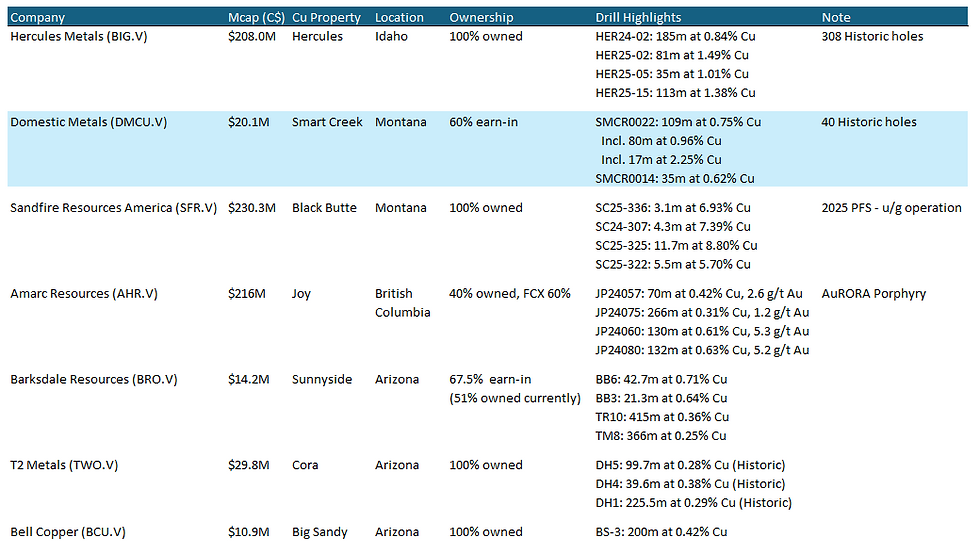
Given the much lower sample size of historic drill results between Hercules and Domestic, the importance of Domestic’s upcoming drilling campaign is apparent. Recall that nearly 2.5 years after Hercules’ discovery hole (October 2023), a maiden resource estimate is only expected by the end of this year.
NORTH AMERICAN BASED PEER GROUP
For comparative purposes, we include both pre-resource and resource companies with active exploration or development projects located primarily in the U.S. (skewed towards Arizona) but include certain Canadian located projects as well.

CONCLUSION & VALUATION
With currently ~C$6.0M in treasury from a recent financing (the final tranche of a 12.080M unit offering issued at C$0.28 per unit closed on April 14, an additional placement of 10.973M units at C$0.28 was closed on May 5) the company has plenty in treasury to execute on the planned drilling campaign. Given that subsequent drilling and analysis from work programs have continued to define the potential mineralization envelope, we feel that the chosen targets for the upcoming drilling campaign have been vectored to the most strategic locations of interest. Building on drill hole SMCR0022, if the center of the copper porphyry would be hit, grades and lengths surpassing that of 109m grading 0.75% Cu should be attained. One can speculate that if successful, an intercept upwards of 150m grading 1.5% Cu at Smart Creek wouldn’t sound unrealistic. Much like the re-rate experienced by Hercules Metals post HER24-02 drill hole (185m grading 0.84% Cu), we feel the same can occur for Domestic Metals. Our 12-month target price of C$0.75 would reflect the magnitude of such an occurrence (arguably still on the conservative side).
We feel that the risk would certainly be on the upside for a successful drilling campaign. Domestic Metals has both the needed data and accomplished team to validate its theory at Smart Creek and locate the center of the copper porphyry. Hardly putting all eggs in one basket, recall that the 9,000m campaign will be spread over 12-16 holes stretching across the four zones on the property. The drill program will target numerous types of mineralization ranging from high-grade porphyry copper targets to CRD/skarn targets, to copper leach targets and epithermal gold targets. Assay results are expected to be announced later this fall.


