Fortune Bay Corp: Trade-Off Processing Studies Further Optimize the Upcoming PFS

DISCLAIMER: Any written content contained herein should be viewed strictly as analysis & opinion and not in any way as investment advice. Visitors to this site are encouraged to conduct their own due diligence. As a Research Spotlight product, HoldCo Markets has received financial compensation for the written content and analysis below. Please read the full disclaimer here: holdcomarkets.com/disclaimer
Fortune Bay Corp. (FOR) announced the completion of a processing trade-off study prepared by Ausenco Engineering ULC, for its wholly-owned Goldfields Gold Project, located in Northern Saskatchewan. The processing trade-off study compared the on-site gold doré production case as outlined in the company’s 2025 Updated Preliminary Economic Assessment (PEA), with an alternative producing a gold-bearing concentrate for sale and treatment off site. The concentrate production option offers distinct advantages such as opportunities to simplify the initial plant, opportunities to reduce the upfront capital requirements and the support for staged development. The option remains for an add-on site doré production facility sometime in the future.

TRADE-OFF STUDY FINDINGS
The completed processing trade-off study evaluated the technical and economic trade-offs between producing a gold-bearing concentrate for sale and treatment off site, and the on-site gold doré production approach outlined in the Company’s 2025 Updated PEA. The study included capital and operating cost estimates and comparative economic analysis using the 2025 PEA financial model, incorporating assumptions specific to each processing option, including metallurgical recovery, concentrate payability and transportation costs. The processing trade-off study provides a useful benchmark for the relative merits of the two processing approaches and a basis for further optimization as the Company advances toward a PFS. Ausenco’s assessment indicates that the doré route provides modestly higher gold recovery, while concentrate production offers a simpler on-site plant, lower initial capital requirements, lower reagent consumption and higher capital efficiency. The concentrate production alternative therefore warrants further evaluation, particularly as part of a staged development strategy.
Management sees scope to further optimize the concentrate production approach beyond the configuration assessed in the processing trade-off study. Potential areas of work include a smaller or staged initial plant, mine scheduling that prioritizes early Box material, contract-mining alternatives, phased tailings infrastructure and further metallurgical optimization, including the role of gravity recovery ahead of flotation. Recall that the existing environmental approval for development of the Box deposit, based on the 2008 Environmental Impact Statement, provides for an open-pit mine and a 5,000 TPD mill, including use of the historical Vic Lake tailings storage facility. Management now have plans to evaluate Ausenco’s findings and recommendations to assess whether the concentrate production scenario could be accommodated within the scope of this approval.
The trade-off study findings will now be integrated with the more recent SGS Canada Inc. results in the next phase of metallurgical and engineering work. This is expected to include representative Box-focused samples, gravity-recoverable-gold characterization, optimization of primary and secondary grind requirements, flotation and cleaning conditions, locked-cycle testing, concentrate dewatering and product characterization. The objective is to determine the simplest practical flowsheet that preserves recovery while reducing capital intensity, power demand, reagent use and execution complexity. Box samples have already been collected from available drill core.
GOLDFIELDS: TARGETING A PRE-FEASIBILITY STUDY BY YEAR-END OR EARLY 2027
Given the completion of an updated Preliminary Economic Assessment in 2025, the current activities at Goldfields are focused on de-risking and refining key project inputs, confirming technical assumptions, and evaluating opportunities to further optimize the Project (as announced today) while advancing the studies required to support permitting and future development planning. Following a successful 4 hole, geotechnical program earlier in May, given favorable waste rock results, some of the current initiatives in addition to the just-announced Project optimization study includes a metallurgical program, environmental, regulatory and community work.
Geotechnical Program - Completed this past April, a 4-hole, 728.9m geotechnical drill program was completed at the Box deposit. The program included packer testing in all holes to assess hydrogeological properties of the lithologies and structures intersected. Vibrating wire piezometers were also installed in two holes to support ongoing groundwater monitoring and geotechnical interpretation. Core samples were collected and will be submitted for laboratory testing. Drill core observations have been found to be consistent with historical geotechnical datasets confirming fair rock mass conditions across the Box pit area, with less competent zones appearing localized. No major continuous fault zones were identified within the Box pit area, which supports the current understanding of the geotechnical conditions at Box.
Waste Rock Characterization Program – several months ago the company received results from a waste rock sampling program initiated in October 2025. A total of 11 composite samples (8 from Box, 3 from Athona) representing different lithological units were submitted to SGS Canada (Lakefield, ON) for acid-base accounting (ABA), metal geochemistry, shake flask extraction testing and Rietveld X-Ray Diffraction (XRD) analysis. Results indicate that all samples are net-neutral, with 9 of 11 samples returning non-potentially acid generating results and two samples returning marginal results as potentially acid generating. Samples contain low to modest total sulphur content and display modest neutralization potential. The results of this testwork were found to be consistent with the historical dataset and have been used to plan a more comprehensive and spatially representative waste rock characterization program for Box and Athona.
Environmental & Regulatory - Goldfields benefits from an existing approved Environmental Impact Statement (2008) for a 5,000 tpd open-pit mine and mill development at the Box Deposit, which provides an important foundation for ongoin7g environmental, regulatory and project planning work. Environmental baseline work is ongoing in support of future permitting and project development. Recent environmental baseline work has focused on updating and expanding the Company’s understanding of current environmental conditions in the Goldfields Project area. Completed terrestrial studies include fire mapping, anthropogenic disturbance mapping and ecosite mapping, which provide updated information to support future project planning, environmental assessment work and field study design. Comprehensive aquatic baseline surveys completed in September 2025 have also been finalized, providing an updated characterization of aquatic habitats, water and sediment quality, and biological communities in eight waterbodies.
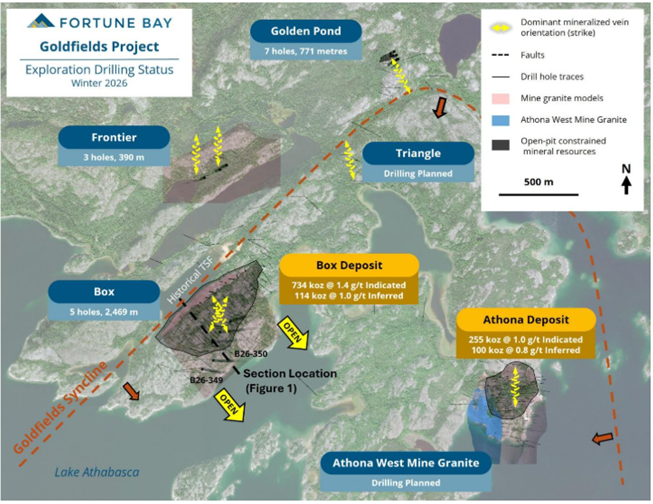
The primary host lithologies to the mineralization are the Box (BMG) and Athona (AMG) granites, the modelled volumes also represent the main resource domains bounded by relatively unmineralized footwall and hanging wall lithological domains. To further constrain the mineralization within the BMG and AMG domains, a vein system model was generated within each of the granite domains. The latest NI43-101 compliant Mineral Resource Estimate models (replacing the MRE with an effective date of October 31, 2022) included a total of 838 boreholes, of which 494 are located within the Box deposit and 344 within the Athona deposit. Gold grades were interpolated into the block models using ordinary kriging (OK) for all granite and vein-set domains within the Box and Athona deposits. Grade estimation for each domain was conducted using multiple passes, with successively expanding search criteria in subsequent estimation passes.

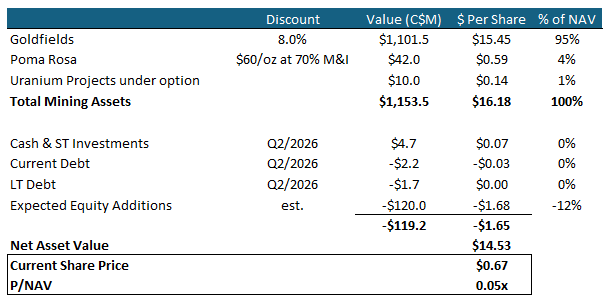
VALUATION & CONCLUSION
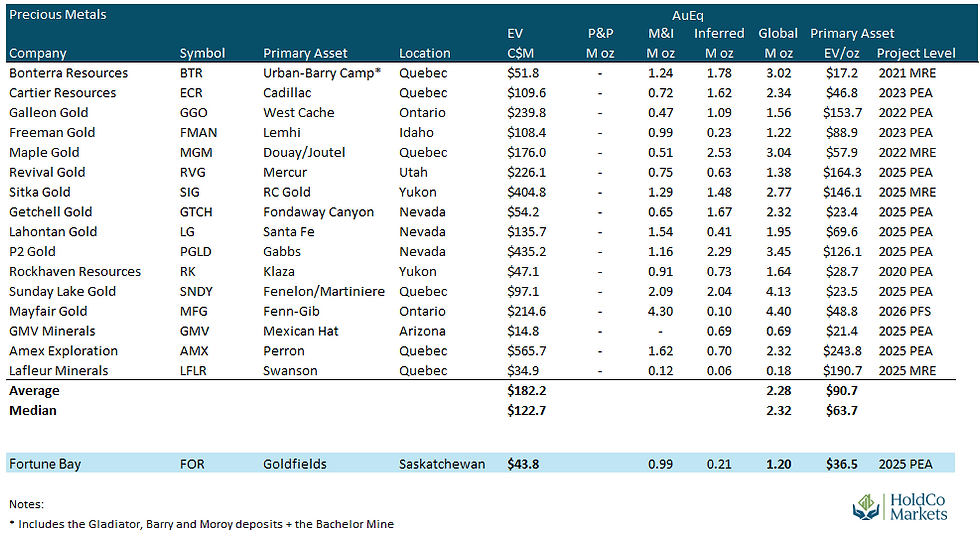
As Fortune Bay advances its flagship Goldfields Project, we continue to value Goldfields using a base case, LT gold price of $4,000 per ounce (near the recent spot at $4,100 per ounce). Factoring in a partial future equity financing (post-PFS provided a positive FID), we derive a 12-month price objective of C$2.00 per share (rounded) by applying a 0.15x NAV8% multiple. Given the most recent close (October 19), shares of Fortune Bay currently trade at a 0.05x P/NAV multiple. As mentioned, Fortune Bay also trades at an attractive EV per ounce value of $52 – well below the peer group. Acknowledging the acute sensitivities to the LT gold price (below), our price objective equates to upside of +198% from the most recent close.

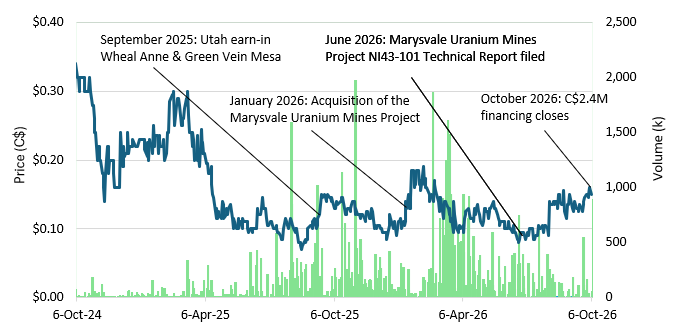
We are excited with Fortune Bay’s prospects this year and note that 2026 will be the first year in which the company should potentially re-rate to being viewed as a pure-play gold company with an advanced project working towards PFS completion by ~year-end. Recall that in previous years, the company was considered as a uranium exploration company focused primarily on the Murmac uranium project. With a PFS expected to be competed in the months ahead, as the story becomes more familiar to the market, we would expect this company to re-rate to similar valuation metrics as seen with the North American Peer group. Moreover, given further evidence that the resource is expanding beyond the historically defined area, we would expect the upcoming PFS to surprise on the upside in terms of production metrics and economics. For additional details, refer to our February 3, 2026 initiation of coverage report.
NEAR-TERM TIMELINE & POTENTIAL CATALYSTS
Metallurgical and Geotech results over the course of the year.
Follow-up drilling at Goldfields.
Goldfields PFS details leading up to an actual study scheduled for year-end or Q1/2027.