Myriad Uranium: Land Position Doubles at Copper Mountain; Raising Estimates

DISCLAIMER: Any written content contained herein should be viewed strictly as analysis & opinion and not in any way as investment advice. Visitors to this site are encouraged to conduct their own due diligence. As a Research Spotlight product, HoldCo Markets has received financial compensation for the written content and analysis below. Please read the full disclaimer here: holdcomarkets.com/disclaimer
This morning, Myriad Uranium (M) announced that via staking, it has significantly increased its land position at the Copper Mountain Uranium Project, located in Wyoming. In total, 8,912 acres were added in strategic areas in both the previously defined Control Area and in the greater Assessment Area of the Project. Using both the recent geophysics program and historic data as outlined in the Bendix Technical Report prepared in 1982 for the U.S. Department of Energy (among others), key acreage was added to both the previously defined Control Area and within the greater Assessment Area. Following the staking program, Myriad now controls 80% of the land contained within the Control Area and 62% of the land contained within the Assessment Area. Our previous resource estimate was solely focused on deposits contained within or very near to the Copper Mountain Control Area. Given now that ownership has expanded to 62% in the surrounding Assessment Area (from 29% previously), our total Project resource estimate has increased to now incorporate a resource estimate from the Assessment Area as well. That said, we increase our resource-driven price objective to C$0.87 per share from C$0.62 per share previously. The updated price objective equates to upside of +55% from the most recent (March 9) close.

STRONG VALIDATION FOR THE LARGE RESOURCE POTENTIAL AT COPPER MOUNTAIN
This morning, Myriad Uranium announced that via staking, it has significantly increased its land position at the Copper Mountain Uranium Project, located in Wyoming. Guided by results from the recently announced high-resolution radiometric and magnetic surveys conducted on the Project, the staking program doubled the acreage under ownership from ~9,439 acres to the current 18,351 acres. Using both the recent geophysics program and historic data as outlined in the Bendix Technical Report prepared in 1982 for the U.S. Department of Energy, key acreage was added to both the previously defined Control Area and within the greater Assessment Area. Following the staking program, Myriad now controls 80% of the land contained within the Control Area (an increase from 70% previously) and 62% of the land contained within the Assessment Area (an increase from 29% previously).

DRILLING CAMPAIGN EXPECTED TO COMMENCE IN Q2/2026
AS data continues to be interpreted, management is currently refining targets for the highly anticipated drilling program, expected to commence next quarter. The focus now is on the verification of anomalies identified through the interpretation of the recently completed high-resolution geophysical surveys. Exploration drilling is expected to follow. Recall that as announced on October 9 2025, the Bureau of Land Management (BLM) approved the Plan of Operations for the company's Copper Mountain Uranium Project. The Plan of Operations was submitted as a technical amendment to the existing Drilling Notification put in place for the 2024 drilling season, when the initial drill campaign took place. The amendment allows for an expanded drilling campaign now comprising up to 222 boreholes spread across the entirety of the project. Under the current Drilling Notification with the State of Wyoming, Myriad is bonded for 70 of those holes (of which, 50 holes are carried over from the Canning area. The Drilling Notification can be updated to bond the remaining holes in subsequent phases.
CONCLUSIONS FROM THE BENDIX STUDY
Prepared in 1982 for the U.S. Department of Energy, the Bendix Technical Report on the Copper Mountain Project (prepared by the Bendix Field Engineering Corporation) was obtained by Myriad last fall. Given the extensive drilling on the Copper Mountain Project during the 1970s and early 1980s (totaling ~2,000 drill holes and 900,000 cumulative feet) the Bendix report amounted to yet another Copper Mountain Technical Report obtained by Myriad. The report covers approximately 2.5 man-years that were used in literature review, field examinations, data compilation, geologic interpretation, and final report preparation. The multi-disciplinary studies were completed during the time that Rocky Mountain Energy Corporation, a subsidiary of Union Pacific, was actively exploring in the district, and who provided property access and critical data, records, and pertinent materials on the project area. Three key conclusions were highlighted in the Bendix Report:
A “Control Area” (17.8 km2) at Copper Mountain, centered on the Canning Deposit, was estimated to have a potential mineral endowment of approximately 245M lbs uranium down to a depth of 600ft in the intermediate grade range of 100–500 ppm eU3O8. Key deposits in the Control Area include Canning, Fuller, Gem and Mint. Myriad (along with partner Rush Rare Metals) together now hold approximately 80% of the Control Area.
A larger “Assessment Area” (103 km2) was estimated to have a potential mineral endowment of approximately 655M lbs uranium, also to a depth of 600ft. Myriad (together with partner, Rush Rare Metals) now holds approximately 62% of this area.
Several probable target areas for extensive intermediate-grade uranium deposits were identified by the study through structural scoring of the Assessment Area. These include locations within the Control Area that previously lacked drill-hole data, and Myriad is now aware of.
Note that detailed subsurface geologic information in the Control Area is a result of close-spaced exploration drilling. The DOE provided (with Union Pacific’s permission) data for 1,193 mineralized boreholes within the Control Area boundary. Bendix also collected its own geological, geochemical (including drilling) and geophysical data for the assessment. This high-confidence area was used for geologic modelling and structural interpretations essential to the assessment. Bendix relied on a vast amount of information for their assessment. This included detailed geological studies (general geology, tectono-depositional analysis, structure and metallogeny), surface geochemical studies (lithogeochemical, soil and stream surveys), subsurface geochemical studies (drilling, spectral radiometric probing and core geochemistry), geophysics (radiometric, magnetic and electrical methods) and emanometric (helium and radon) studies. The information was a combination of data provided by Union Pacific and data collected by Bendix.
HISTORIC RESOURCE ESTIMATES, TECHNICAL REPORTS & FOLLOW-UP REVIEW STUDIES
In 1978, RMEC estimated Copper Mountain’s resource estimate potential to be as high as 63.8M lbs when factoring in “just” 2 of the 5 identified deposits (Canning and Fuller). At a 0.01% eU3O8 grade cut-off, the resource estimate from the Canning pit alone was estimated to be 21.1M lbs U3O8. In 1980, Fluor followed up with a study of its own (commissioned by RMEC) in what was considered to be a much more conservative estimate due to the methodology used - conditional lognormal probability distributions. Using the chosen conditional probability, Fluor applied a delayed fission neutron (DFN) adjustment which reduced the grades. Ultimately, an estimate of 14.6M lbs was calculated for Canning and parts of four other surrounding deposits (Fuller, Mint, Allard and Hesitation).

The Fluor estimate was reported as a “geostatistical ore reserve analysis” mostly for the Canning area however small portions from surrounding uranium deposits were also included in the analysis. Fluor’s goals as per the analysis were the following:
correction for “disequilibrium”.
construction of a three-dimensional dowel-rod model.
geostatistical structural analysis.
determination of global grade-tonnage curves.
creation of a computerized block model.
development of a bulk sampling program.
Fluor investigated various resource estimation techniques including polygonal methods, cross-sectional methods, ordinary kriging, and a method using conditional lognormal probability distributions, which was the chosen method. Use of the DFN factor to calculate grades coupled with the use of conditional lognormal probability distributions made the study somewhat controversial owing to the conservative nature of the resulting data output.
In 1991, Anaconda Resources Inc. commissioned a Summary Report on Copper Mountain, using both the RMEC and Fluor reports as a basis, however incorporating development work to date as well. The Summary Report was conducted by Gregory Liller who confirmed the Copper Mountain deposit to be not only amenable to heap leach, but also as an economically viable project (among other conclusions). In 1997, Anaconda Uranium Corporation commissioned A.C.A Howe International Ltd to prepare a second Summary Report study on the Project. Prepared by Bojan Zabev, preparation for the study included a database no included in the original reports. The Zabev report included a comparison between natural gamma probe and delayed fission neutron (DFN) derived U3O8 grades as generated by RMEC. Incorporating the Canning deposit along with portions of 6 other deposits (Fuller, Mine, Allard, Hesitation, Arrowhead and Gem) the Liller and Zabev reports were summarized as seeing the total resource between a range of 15.7M-30.1M lbs U3O8.
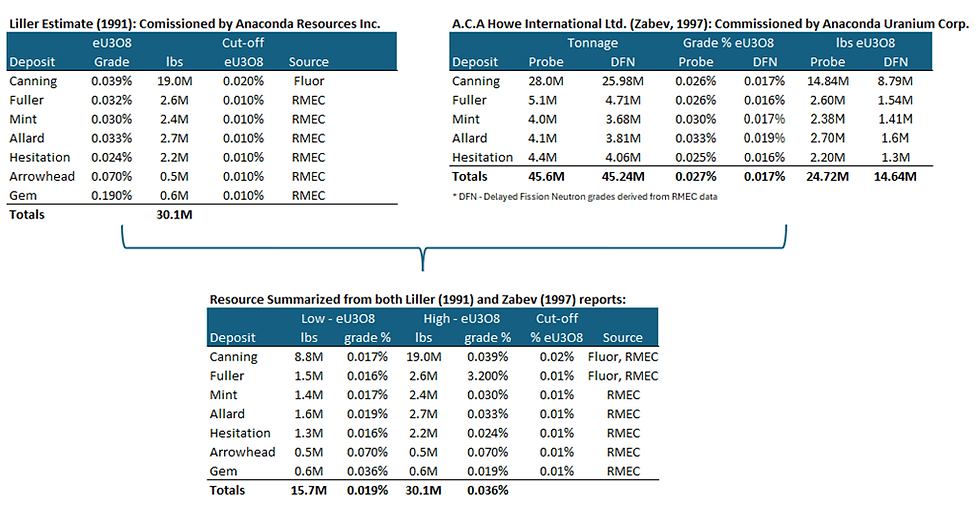
Though historic in nature, the vast array of geological data received from the 900,000+ ft of historic exploration conducted at Copper Mountain ultimately serves to partially de-risk the Project while also serving to provide a basis for benchmarking expectations. The various studies and methodologies applied for resource estimation also serves to study and stress test the deposit assumptions. Data from the Bendix study will further stress test and fine tune the estimates and targets going forward. A historic deposit summary ranging between 15.7M-30.1M lbs U3O8 is an excellent starting point to resume exploration activities. It is worth noting that in 1982, referencing the Bendix study, the US DOE stated that Copper Mountain’s potential may be 200M lbs in the known deposit areas. Myriad is in possession of that full 600 page study.
VALUATION & CONCLUSION
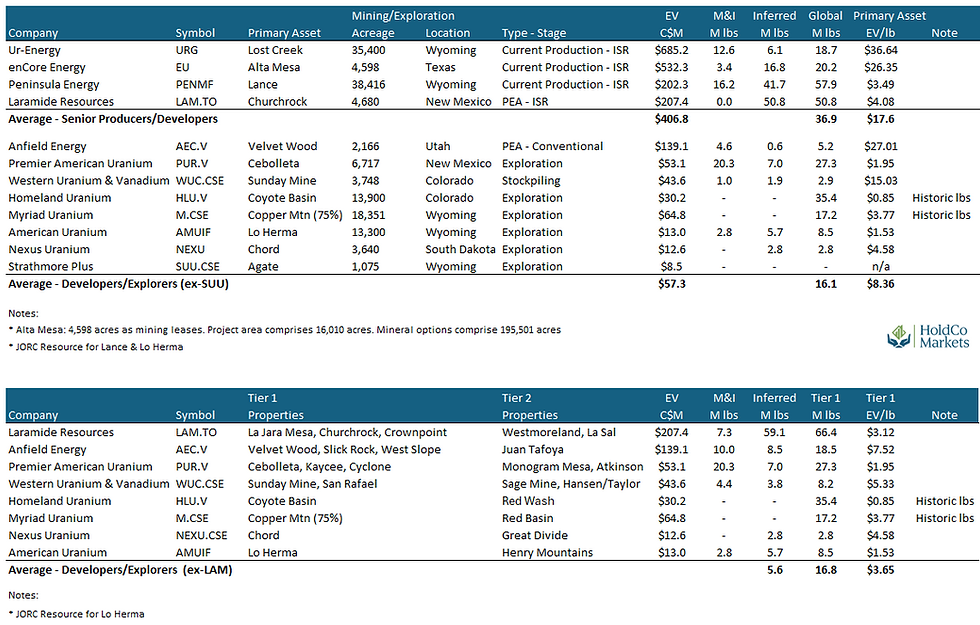
We note that the entirety of our resource estimate was based on a weighted mid-point anchored by historic resource estimates compiled by numerous technical reports, as outlined above. Our previous resource estimate was solely focused on deposits contained within (or very near to) the Copper Mountain Control Area. Given now that ownership has expanded to 62% in the surrounding Assessment Area, our total Project resource estimate has increased to now incorporate our own resource estimate from that larger area as well. As we continue to use a weighted historic mid point resource estimate for the Control Area, now incorporating an estimate for the Assessment Area, our total resource estimate for the Copper Mountain Project increases to 40.1M lbs, from 25.1M lbs previously. Though we acknowledge the conservative estimate relative to the numerous historic reports, our current resource estimate now ranks the Copper Mountain as one of the larger uranium projects located in the U.S.

The potential to confirm the historic Copper Mountain resource is apparent, but so is the potential to expand and grow the resource – as was evidenced by the recent geophysics conducted at Copper Mountain. Pending positive drilling success, the risk remains on the upside for a continued valuation re-rate higher. With a highly anticipated Q2/2026 drilling campaign about to begin, we see many near-term drivers on the horizon. We also look forward to the successful consolidation of the Copper Mountain Project given the Definitive Merger Agreement announced on February 13 with Rush Rare Metals Corp (RSH).


We continue to apply our $3.25 per lb in-situ valuation along with a target NAV multiple of 0.60x. Using the historic resource as a weighted benchmark and now incorporating an estimated resource for the Assessment Area, our price objective increases to C$0.87 per share, from C$0.62 per share previously. This equates to potential upside of +55% from the most recent close on March 9. Shares currently trade at a 0.42x P/NAV multiple.
NEAR-TERM TIMELINE & POTENTIAL CATALYSTS
Start of drilling at Copper Mountain - Q2/2026.
Merger with Rush Rare Metals. Special Rush shareholder meeting before May 2026.
Regulatory approvals for the Rush merger.
An eventual NI43-101 resource estimate for Copper Mountain.
An eventual TSXV listing and/or a US listing.