Terra Clean Energy Corp: Expanding into Utah/Wyoming with Strategic Uranium Acreage

DISCLAIMER: Any written content contained herein should be viewed strictly as analysis & opinion and not in any way as investment advice. Visitors to this site are encouraged to conduct their own due diligence. As a Research Spotlight product, HoldCo Markets has received financial compensation for the written content and analysis below. Please read the full disclaimer here: holdcomarkets.com/disclaimer
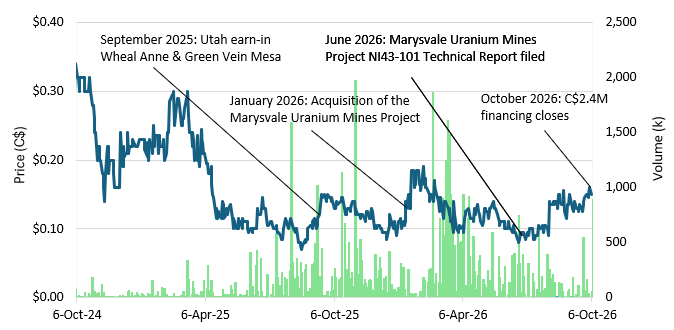
Since last September, Terra Clean Energy Corp (TCEC) management has been successful with identifying strategic uranium properties and then either staking or negotiating earn-in agreements at what we deem as a modest capital outlay with meaningful ownership milestones. The claims on past producing properties in Utah include valuable historic data compiled by the US Geological Survey (among others). Combined with the use of modern exploration techniques and 3D modeling, management will use the historic data to identify priority targets for confirmation drilling in identified zones and exploration drilling to test for extensions. Ultimately, the near term work will be to confirm, identify and define the uranium mineralization on site. With a recent financing closed, successful staking/acquisitions in Wyoming and two recent Utah earn-in agreements finalized, given the compelling re-focus of the company, we are re-launching research coverage and establish a price objective of C$0.30 per share. This equates to upside of +114% from the recent close.
DIVERSIFYING THE URANIUM PORTFOLIO: STRATEGIC ACQUISITIONS IN UTAH & WYOMING
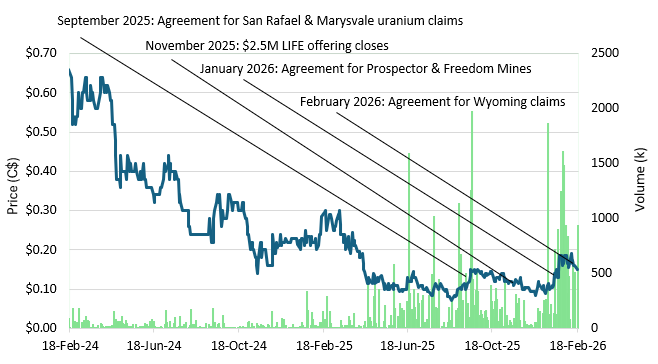
Last September, Terra announced its entry into Utah by way of an earn-in agreement for 75 uranium claims located in Emery County. This news was followed up this past January with the announcement of another earn-in agreement encompassing 6 Bureau of Land Management (BLM) unpatented Lode Mining Claims located in Piute County, Utah. Both claim areas are strategically located within 150 miles of the White Mesa Mill (owned by Energy Fuels, UUUU) and the Shootaring Canyon Mill (owned by Anfield Energy, AEC). Both claim areas contain numerous near surface, past producing, uranium mines. Just as importantly, management has also secured numerous historic technical reports conducted on the properties - these reports will be used as the basis to formulate and eventually coordinate the first targeted drilling program seen on the properties in 50+ years.
Additionally, as announced earlier this week, by way of staking and State lease acquisition, a total of 3,395 acres in Wyoming were added to the company’s current portfolio of prospective uranium properties. Situated near the Colorado state border, the contiguous land package in the southern flank of the Washakie Basin is located in close proximity to enCore Energy’s (EU) Juniper Ridge uranium deposit and Homeland Uranium’s (HLU) Coyote Basin Project.
With these latest property acquisitions and with the earn-in agreements in place, Terra now boasts a diversified portfolio of uranium properties located in some of North America’s premier uranium districts – the Athabasca Basin (South Falcon East), the Marysvale Uranium District (Prospector & Freedom Mines), the San Rafael District (San Rafael West) and the Washakie Basin (Wyoming Claims). With a financing closed last November, the stage is set to re-examine the historic data and plan for a high impact drilling program. Next month, prospecting, trenching and mapping will commence at the Prospector & Freedom claims. Permitting for a 10,000ft drilling program will also commence in March. Drilling is ultimately planned to begin in May/June.

Both the Marysvale claims and the San Rafael claims benefit from easy access to site via main road and secondary gravel road to get to site. Marysvale is located ~300km due south of Salt Lake City while the San Rafael Swell is located ~300km east of Marysvale. The area's well documented uranium endowment is further exemplified by the nearby infrastructure – the currently operating White Mesa mill and the currently on stand-by Shootaring Canyon mill are located in close proximity, within 300km of either property. Established uranium mines such as the Sunday Complex (owned by Western Uranium & Vanadium, WUC) and the La Sal Complex (owned by Energy Fuels, UUUU) are located within 200kms of the San Rafael.

PROSPECTOR & FREEDOM MINES PROJECT - MARYSVALE, PIUTE COUNTY, UTAH
As announced on January 26, 2026, the earn-in agreement for the Marysvale property encompasses six (6) contiguous BLM unpatented Lode Mining Claims totaling 39.5 hectares located in Piute County, Utah. The claims cover four past producing uranium mines (the Prospector 1 Mine, the Prospector 4 Mine, the Buddy Mine and the Lucky Strike Mine). Collectively, the Marysvale district produced over 1.33M lbs at a reported grade of 0.22% U3O8. It is estimated that 75% of that historic production (~1.0M lbs U3O8) came from the Prospector and Freedom mines. The claims are located ~5km northeast of the village of Marysvale.
The Marysvale District hosts nearly vertical, northeast and east striking fissure veins that cut granitic and volcanic rocks of the Belknap volcanic sequence and is a prime example of an epithermal vein-style uranium system. Ore is located within the north-northwesterly striking, near vertical, Prospector Fault. Uranium in the area was discovered in 1948 and mining commenced in 1949 by Vanadium Corporation of America (VCA). Over the next few years they consolidated various claims and operations in the area. Production ceased in the Marysvale area in 1969. Some exploration drilling was undertaken in the area in the late 1970’s.

A Technical Report authored by the US Department of the Interior Geological Survey dated September 1950 specified that inclined shafts were sunk on the Prospector 1 and Freedom 2 claims. The first ore mined was trucked to Naturita, Colorado, for experimental processing. Subsequent ore was stockpiled near the mines with much being purchased by the American Smelting and Refining Company under the authority of the Atomic Energy Commission.
Uranium Mineralization
As described in the Technical Report, within the near surface parts of the Marysvale deposits, uranium mineralization occurs along northeast- striking fault zones and is localized by structure and rock types. From the Prospector 1 shaft, the most prominent uranium-bearing vein follows an intensely iron-stained gouge zone that strikes N. 65° E., and dips nearly vertically. The general trend of the fault zone is evidently parallel to this vein, but subsidiary veins that generally strike N. 80° E. to N. 85° W. and dip northerly about 75° to 85° are common as well. The prominent vein in prospect pits numbers 1 and 2 strikes N. 55° - 60° E. and is nearly vertical. The ore bodies are seemingly narrower in the lower parts of the Freedom 2 and the Prospector 1 shafts, possibly because the inclined shafts depart from the plunge of the ore shoots.
Rocks in and near the uranium mines were tested for radioactivity with a Beckman MX-5 portable beta-gamma counter. From the Prospector mine, meter readings were recorded at 10-foot intervals with the probe held at waist height in the middle of the shaft and drift.

In terms of assays, samples were assayed for uranium, phosphorous and manganese to determine the relationship between uranium and these other elements. It was discovered that rock within the uranium bearing vein zones ranged from between 0.004%-1.36% U3O8. Samples were assayed for uranium, phosphorous and manganese (below) to determine the relationship between uranium and these other elements. A total of 106 rock samples were taken from three mines, three prospect pits, and outcrops near the mines.
Uranium mineralization was found to be most abundant in the intensely argillized rock. In the ore zone in the Prospector 1 mine, the intensely argillized rock assays about 0.38 % uranium, the quartz veins 0.16%, the moderately argillized rock 0.08%, and the weakly argillized rock 0.05%. The ore in the Freedom 2 Mine was found to be of lower grade. In the ore body the intensely argillized rock assays 0.19% uranium, the quartz veins 0.09%, moderately argillized rock 0.04%, and weakly argillized rock 0.03%.

GREEN VEIN MESA & WHEAL ANNE CLAIMS - SAN RAFAEL WEST, EMERY COUNTY, UTAH
As announced on September 16, 2025, Terra management negotiated an earn-in agreement for 75 uranium claims in the San Rafael Swell. The San Rafael Swell is a large, uplifted, doubly-plunging anticline in east-central Utah and the Swell forms part of, but contrasts with the surrounding flat-lying rocks, of the Colorado Plateau, a significant uranium mining district in the Western United States. Historical uranium production was undertaken in the Swell between the late 1940’s until 1969 when approximately 7.0M lbs U3O8 was produced. No significant work has been completed in the region over the past 50 years.
The rocks in the San Rafael Swell are predominately sedimentary (Pennsylvanian through Cretaceous), including Triassic and Jurassic formations which are known to host uranium. The project area is underlain by Triassic aged sedimentary rocks of the Moenkopi and Chinle formations. The Chinle outcrops in a continuous belt around the San Rafael Swell and on isolated buttes through the center of the swell. It is widely believed that volcanic ash is the source of uranium for many deposits in the swell. All existing mines and prospects in the Chinle are in the lower, bentonitic part of the Chinle in channel-fill sandstone and surrounding siltstones of the lower Chinle Formation.
The two claim groups (Wheal Anne and Green Vein Mesa) are located 10km apart. The Wheal Anne Claim Group (16 claims) is the southwest of the two and encompasses approximately 130 hectares covering the former producing Lucky Strike Mine and related uranium occurrences. Historic production from mines contained on both claim groups contributed to approximately 450,000 lbs of uranium production.
The Green Vein Mesa claim group (32 claims) is located to the northeast encompasses approximately 300 hectares. The claims cover the former producing Payday Mine, Hertz Mine, and Green Vein group of mines. The Hertz Mine reportedly had local samples up to 1.00% U3O8. Historic production numbers for these mines totaled approximately 400,000 lbs U3O8. The Wheal Anne claim group (16 claims) is highlighted by the Lucky Strike Mine which was discovered in 1949 and historically produced approximately 44,000 lbs U3O8 (10,000 tons grading 0.22% U3O8).

Each of the Wheal Anne, Green Vein Mesa and Prospector & Freedom Mines’ claims are subject to a 2% net royalty. For each of the individual claims, Terra has the option to purchase 50% of the respective royalties. The negotiated earn-in terms represent modest payments which rightfully prioritize exploration spend. The milestones to achieve meaningful ownership stakes are very modest and attainable in our view.

WYOMING CLAIMS – WASHAKIE BASIN, SWEETWATER COUNTY, WYOMING
As announced earlier this week, Terra acquired via staking 2,068 acres of new prospective uranium exploration claims on 100 unpatented BLM Lode Mining Claims. Additionally, Terra acquired three Wyoming State Leases covering 1,327 acres of land. These newly acquired lands are located in the southern flank of Wyoming’s Washakie Basin, just to the north of the state border with Colorado. The staked ground covers two historical uranium occurrences which occur in limonite altered fractured sandstone. Samples from prospecting pits have returned grades including 0.375%, 0.083% and 0.058% U3O8. The claims are ripe for exploration seeing as minimal work has been conducted in the area since the mid 1980s.
The Washakie Basin is a large syncline that forms a topographic plateau south of Interstate 80 and west of State Highway 789 within the greater Green River Basin in Wyoming. The Washakie Basin is a structural low where sedimentary rocks accumulated and hosts uranium mineralization relevant to mining projects. enCore Energy’s Juniper Ridge deposit (6.01M lbs U3O8 Indicated, 0.18M lbs U3O8 Inferred estimated in a 2017 NI43-101 PEA Report) is located approximately 120km to the east of the claims.
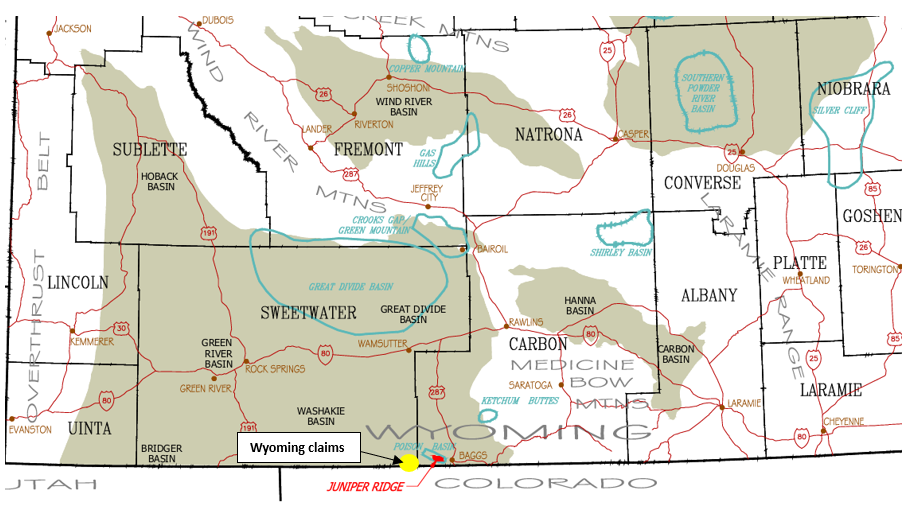
Within Wyoming’s Washakie Basin, uranium was first discovered in 1951 and commercial uranium mining occurred intermittently from 1954 until 1966. Seven companies mined uranium from twelve open pits and two shallow underground mines. During this time a total of 156,000 tons of material with an average grade of 0.172% U3O8 were mined resulting in production of 536,000 lbs of uranium. Some of the historic mining occurred just 75km east of the claims, within the Poison Basin area, west of the town of Baggs, Wyoming. Also of note is that Homeland Uranium’s (HLU) Coyote Basin Uranium Project is situated approximately 145km south of the claim areas. Note that Coyote Basin hosts a historic (1980) resource estimate amounting to 8.85Mt grading 0.20% U3O8 for 35.4M lbs.
As seen below, a topographic geological map shows the staked claims (2,068 acres) in red and state leases (1,327 acres) in blue. The light brown area is the Browns Park Formation which has long been recognized as favorable for sandstone hosted roll-front style uranium deposits. The red dots illustrate previously identified uranium occurrences.

SOUTH FALCON EAST – ATHABASCA BASIN, SASKATCHEWAN
Strategically situated at the periphery of the Athabasca Basin, the South Falcon East Project is located 50km east of Cameco's (CCJ, CCO) Key Lake uranium mill and just 7km north of the powerline servicing the Key Lake operations. As previously defined, the Fraser Lakes B deposit currently hosts a NI43-101 compliant uranium resource (Inferred) estimated to be 10.35Mt grading 0.03% U3O8 for 6.96M lbs, along with thorium (ThO2) mineralization. Mineralization remains open both down dip and along strike. The property encompasses 18 claims totaling 12,234 hectares. Terra has a 75% earn-in agreement with Skyhrabour Resources (SYH) for the property. Though lower-grade, the deposit is relatively shallow and situated near key infrastructure. The deposit is characterized with Rossing-style mineralization given that the deposit is associated with intrusive rocks such as granitic pegmatites and alaskite.

Recall that this past March/April, Terra announced the results from its winter 2025 drilling campaign at the South Falcon East Uranium Project, located at the periphery of the south-eastern edge of the Athabasca Basin. With six of seven drill holes encountering uranium mineralization, the large-scale winter drill campaign consisting of 1,927m drilled was successful on numerous fronts. Though the gamma results were previously disclosed in the spring, the actual chemical assays as released yesterday have yielded highlight wider intervals of mineralization with higher grades than those identified within the probe.
Some of the latest assay results released this past summer represent the best intercepts achieved to date, with notable grade improvement to the north, along the NW fault. The northernmost hole, SF-0067, returned 3.87m at 0.05% U3O8, including a sub interval of 0.17% U3O8 over 0.5m. This 0.5m interval represents the best sample of the program. Note that it is not out of the ordinary for the lab results to be higher than the equivalent gamma results. The variation is on average +5% to +30% higher, with the large range of variation due to dealing with the overall grades, with a small difference in grade leading to a larger apparent variation. Highlight intercepts include:
SF-0067: 3.87m at 0.05% U3O8, including 0.17% U3O8 over 0.50m
SF-0067: 8.05m at 0.03% U3O8, including 0.16% U3O8 over 0.50m
SF-0065: 3.72m at 0.09% U3O8, including 0.13% U3O8 over 0.51m
SF-0066: 3.44m at 0.06% U3O8, including 0.12% U3O8 over 0.65m
The typical pathfinder elements used to vector towards uranium in the basin, cobalt (Co), nickel (Ni), copper (Cu), lead (Pb) and zinc (Zn) all appeared elevated within the metasedimentary package hosting the mineralized pegmatites, in particular cobalt and nickel. Note that elevated lead is closely associated with elevated uranium. Hole SF-0067 contains some of the higher pathfinder values, indicating another vector towards the north. Several drill holes returned high-grade values, including as much as 466% greater than the current deposit average.

CONCLUSION & VALUATION
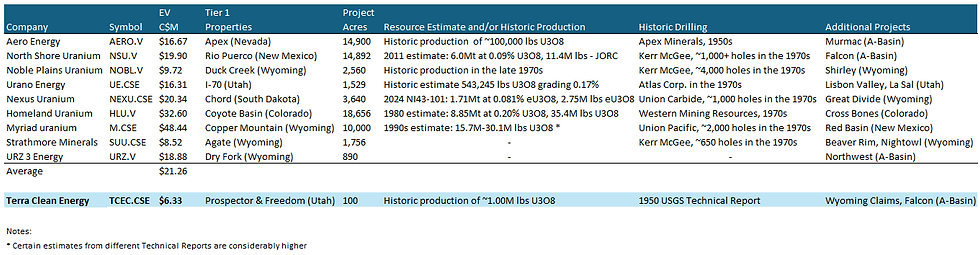
Our US-based peer group is populated with pre-resource companies which have active programs largely in the Four-Corner states or in Wyoming. Moreover, much like Terra’s new US Projects, the respective peer-group Projects also either contain a certain degree of historic production and/or contain a certain historic resource estimate. Particularly for a pre-resource company, these are the factors we consider as critical when it comes to choosing Projects worthy of development capital, formulating future drill programs and then the publishing (hopefully) of an updated mineral resource estimate (MRE).
Ultimately, valuing any pre-resource exploration company is difficult, however by analyzing historic drill results and by sifting through historic technical reports - therein ultimately lies the opportunity at this early stage. Given Terra's acquisitions, the opportunity now is with the continued de-risking of the assets and with the upcoming drill program on the Prospector & Freedom claims. With ~C$2.0M currently in treasury (equating to nearly 25% of mcap) and with Definitive Agreements on the Utah claims now closed, management is well setup to conduct the trenching, prospecting and mapping program, expected to commence in the weeks ahead. Permitting is also expected to begin next month, at which point it is hoped that a 10,000ft drilling program will get underway in May/June.
In addition to the strategically located and highly prospective claims, we give a great deal of credit to management for recognizing the opportunity in Utah and Wyoming and acting accordingly with the speed needed to stake, negotiate and then ultimately close on transactions. The new Utah and Wyoming claims have drastically re-positioned Terra onto a new course and into jurisdictions which have a long history with uranium mining. On the way, a C$2.5M financing was raised. Management has executed on a lot over the last five months, we are very constructive on the new claims and with the near-term development plans.
On an EV basis, Terra currently trades at a ~70% discount to the peer group listed above. We feel that this is currently justified given the constraints weighing on the company such as company size and liquidity. Moreover, the new direction positioned towards Utah and Wyoming coupled with the very modest and attainable earn-in conditions remain largely unknown to the market. This dynamic will change as the new assets will slowly de-risk as development ramps and milestones are made.
We feel that our price objective of C$0.30 per share is still rather modest despite a +114% increase to the most recent (February 18) close. At price objective, Terra’s EV would still equate to be at a discount to the peer group (25%), albeit not as pronounced. The road map is clear: plan, prospect, permit then drill. For any exploration company, for de-risking to occur, prospective assets have to be twinned with a management team that has the skill, know-how and drive to get things done. This much has been proven by Terra’s management team over the last five months alone.
NEAR-TERM TIMELINE & POTENTIAL CATALYSTS
Trenching, prospecting and mapping in and around the Prospector & Freedom Mine claims.
Permitting for an eventual 10,000 ft drilling program.
Drilling program expected to commence in May/June
UTAH, THE MOST ATTRACTIVE LOCATION FOR MINING
Already hosting a rich mineral endowment comprising a multitude of critical minerals and rare earths, Utah has quickly been positioning itself as the premier state for mineral exploration. In 2023, the Fraser Institute identified Utah as the world’s most attractive location for mining investment not only due to the rich mineral endowment, but also due to what it considered as the best regulatory environment for mining companies. More recently, Governor Cox has unveiled a “Mission Critical” mine-to-market strategy for critical mineral development. This strategy emphasizes speed, clarity and transparency. This year alone, Utah has plans to approve five mining projects and to bring a national lab to the state by 2031. Paramount to the Governor’s “Mission Critical” strategy is to fast track permitting, provide domestic mining incentives and to prioritize national security and supply chain strategies.