Terra Clean Energy: Work Permits Received for the Marysvale Uranium Mines Project

DISCLAIMER: Any written content contained herein should be viewed strictly as analysis & opinion and not in any way as investment advice. Visitors to this site are encouraged to conduct their own due diligence. As a Research Spotlight product, HoldCo Markets has received financial compensation for the written content and analysis below. Please read the full disclaimer here: holdcomarkets.com/disclaimer
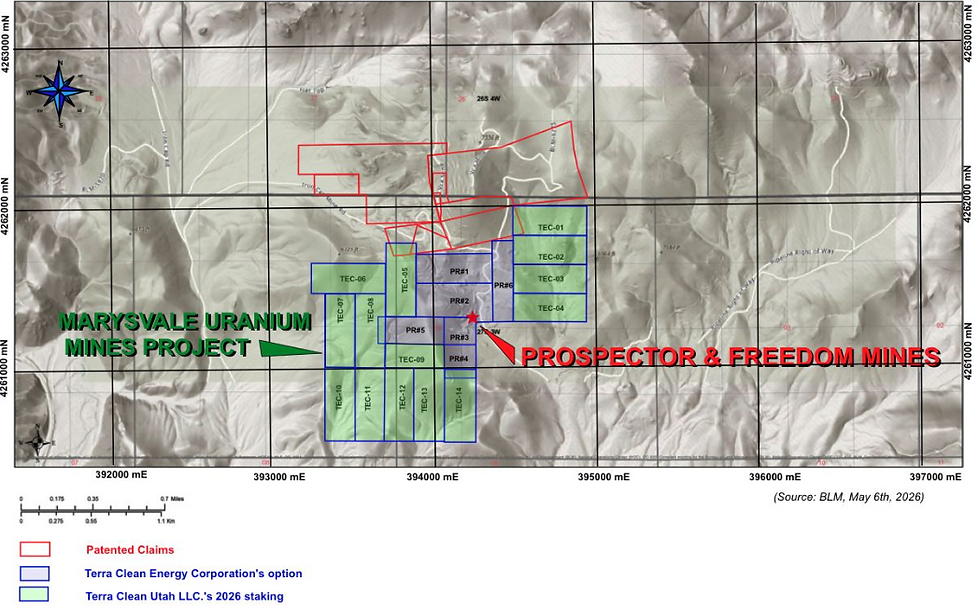
Terra Clean Energy Corp. (TCEC) announced that it has received the required permits from the Utah Department of Natural Resources Division of Oil, Gas & Mining to begin the planned exploration program at the wholly-owned Marysvale Uranium Mines project, located in Marysvale, Utah. The announced permit receipt allows for the construction of five drill pads to support the planned diamond core drill program and excavation of seven exploration trenches designed to expose and evaluate known uranium-bearing outcrops. Starting first, the trenching program will provide additional data to the Terra technical team with regards to the verification of historical geological interpretations. Moreover, the trenching program will refine the final drill targets ahead of the planned 10,000ft drilling campaign. The trenching program is expected to commence shortly.

Expected to begin towards the end of August, the trenching program will allow Terra’s technical team to map and sample mineralized structures, verify historical geological interpretations, and refine drill targets ahead of a planned diamond core drilling program this fall. The five permitted drill pads have been strategically positioned to test priority uranium targets previously identified through historical exploration, recent geological modeling, and the company’s completed radiometric and photogrammetric surveys. Recall that earlier this spring, a radiometric survey outlined numerous discrete uranium anomalies associated with favorable host lithologies and established regional mineralized trends. These anomalies are interpreted as potential near-surface uranium-bearing zones and represent compelling follow up targets for the company’s upcoming ~10,000ft drilling program. Terra expects field crews to mobilize in September once a small Surety Bond is posted with the BLM for reclamation post field work.
THE MARYSVALE URANIUM MINES PROJECT
Terra’s 20 claims cover four past producing uranium mines (the Prospector 1 Mine, the Prospector 4 Mine, the Buddy Mine and the Lucky Strike Mine). Collectively, the Marysvale district produced over 1.33M lbs at a reported grade of 0.22% U3O8. It is estimated that 75% of that historic production (~1.0M lbs U3O8) came from the Prospector and Freedom mines. The Marysvale District hosts nearly vertical, northeast and east striking fissure veins that cut granitic and volcanic rocks of the Belknap volcanic sequence and is a prime example of an epithermal vein-style uranium system. Ore is located within the north-northwesterly striking, near vertical, Prospector Fault. Uranium in the area was discovered in 1948 and mining commenced in 1949 by Vanadium Corporation of America (VCA). Over the next few years they consolidated various claims and operations in the area. Production ceased in the Marysvale area in 1969. Some exploration drilling was undertaken in the area in the late 1970’s. A Technical Report authored by the US Department of the Interior Geological Survey dated September 1950 specified that inclined shafts were sunk on the Prospector 1 and Freedom 2 claims. The first ore mined was trucked to Naturita, Colorado, for experimental processing. Subsequent ore was stockpiled near the mines with much being purchased by the American Smelting and Refining Company under the authority of the Atomic Energy Commission.
BROWNFIELD URANIUM ASSETS INCREASINGLY IN DEMAND
The recent creation of DISA Uranium Corp. (as announced on August 4, 2026) is further evidence that brownfield uranium projects are increasingly being viewed as not only strategic assets, but compelling from a long term development and investment standpoint as well. Backed by a syndicate of high profile investors, the announced IsoEnergy definitive agreement with DISA Technologies to form DISA Uranium shows the will to acquire and consolidate brownfield projects. Moreover, as is the DISA strategy, the application of modern development methods is seen as a primary driver to unlocking value. Note that the Marysvale Project is located 115 miles from DISA’s Tony M mine and is accessible by road after a two hour drive.
By leveraging decades worth of historical work (including drill programs, mapping, geophysics, previous permitting and/or production), our view has always been that provided good project data and mineralization, a brownfield project opportunity will always provide a better risk-adjusted return when compared to a much riskier greenfield opportunity. The announced transaction with DISA and IsoEnergy validates our investment thesis, as does the impressive investor syndicate participating in the private placement. According to DISA, HPSA technology can be used to remediate the estimated 15,000 abandoned/mothballed uranium mines scattered throughout the western United States. Refer to our August 13, 2026 note for additional details on this front.
CONCLUSION & VALUATION
Though Terra’s uranium portfolio continues to be anchored by the 6.8M lb South Falcon East deposit, the recent US acquisitions have fundamentally changed the profile of the company. Since last Fall, Terra management has been successful with identifying strategic uranium properties and then either staking or negotiating earn-in agreements at what we deem as a modest capital outlay with meaningful ownership milestones. The claims on past producing properties in Utah include valuable historic data compiled by the US Geological Survey (among others). Combined with the use of modern exploration techniques and 3D modeling, management will use the historic data to identify priority targets for confirmation drilling in identified zones and exploration drilling to test for extensions. The completion of a NI43-101 compliant Technical Report is a culmination of all the efforts conducted thus far. This latest permit approval marks the latest step in the de-risking effort at Marysvale. We look forward to the upcoming trenching program, followed by the high impact 10,000ft drill program.
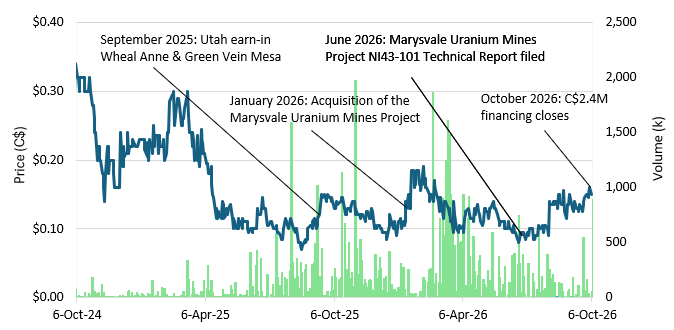
Given a revamped management team, a newly re-constituted Board and Terra’s recent initiatives into Utah and Wyoming, much new interest has been re-injected into the company. We note that the average trading volume YTD has nearly tripled the average daily figure from 2025. Ultimately, we look forward to the start of two high impact drilling programs – more immediately at the Marysvale Project and then at South Falcon East ,in the Athabasca Basin. Underpinned by our $4.75 per lb in-situ valuation for 51% ownership of South Falcon East, our 0.60x NAV multiple leads to our C$0.22 per share price objective. This implies upside of +57% from the recent close (August 14). For additional asset-specific information refer to our research report dated February 19, 2026.


NEAR-TERM TIMELINE & POTENTIAL CATALYSTS
Trenching program at the Marysvale Project beginning towards the end of August.
Start of the ~10,000 ft Marysvale drilling program this fall.
Details for the upcoming South Falcon East drill program in the Athabasca Basin.