Western Uranium & Vanadium Corp: Ore Delivery Program Concluded, Once Again...Very Few Details
- HoldCo Markets

- Jul 8
- 9 min read
DISCLAIMER: Any written content contained herein should be viewed strictly as analysis & opinion and not in any way as investment advice. Visitors to this site are encouraged to conduct their own due diligence. As a Research Spotlight product, HoldCo Markets has received financial compensation for the written content and analysis below. Please read the full disclaimer here: holdcomarkets.com/disclaimer
On July 7, Western Uranium & Vanadium Corp. (WUC) announced the successful conclusion of its Uranium Ore Delivery Program from the Sunday Mine complex to Energy Fuel’s White Mesa Mill, located in Blanding, Utah. The company noted that the final chemical assay results exceeded initial probe indicated estimates. Specifically, post-processing assays showed natural uranium grades were more than 40% higher than the initial probe estimates at delivery. As is the nature of testing via gamma probe, we don’t find this fact to be overly surprising. That said, if these higher assay results prove to be representative of the entire or a portion of the unmined and unexplored areas of the Sunday Mine Complex, it may indicate that the mineral resource exceeds significantly the original estimates derived from prior drilling data reported in the Technical Report on the Sunday Mine Complex dated from 2015. Lastly, the financial component to this would be a higher expected payment to Western for the delivered ore. If there were additional sales made, we are still lacking the amount and consequently, the financial consequence of the sales. We maintain our C$0.55 per share, 12-month price objective. We think that shares are currently fairly valued.

When the Ore Delivery Program was initially announced on April 14 2025, all that was specified was the agreement was signed with Energy Fuels for a one year period for the delivery of up to 25,000 short tones of uranium bearing ore stockpiled at Western’s Sunday Mine Complex. Though actual pricing was not mentioned, there was reference to “the purchase price will be calculated based upon the uranium grade of each closed lot according to the agreed pricing schedule”. The latest update since was on April 15 2026 when it was stated that during the June through September 2025 period, approximately 1,600 tons were delivered under the Ore Purchase Agreement. Moreover, it was stated that at the end of the year, recognized revenue from the sale of ore amounted to $297,285. Note that deliveries were paused at the end of September. There has been no mention of any additional ore sold under the Agreement since the pause. We also stress that initial gamma probe results being lower than natural uranium grades is nothing out of the ordinary. On a down day in the markets, shares of WUC hardly reacted to the news and closed down -5.4%.
STILL VERY FEW DETAILS ON THE COMPLETED ORE PURCHASE AGREEMENT
When the Ore Delivery Program was initially announced on April 14 2025, all that was specified was that an Ore Purchase Agreement was signed with Energy Fuels for a one year period for the delivery of up to 25,000 short tones of uranium bearing ore stockpiled at Western’s Sunday Mine Complex. Though actual pricing was not mentioned, there was reference of “the purchase price will be calculated based upon the uranium grade of each closed lot according to the agreed pricing schedule”. The latest update since was on April 15 2026 when it was stated that during June through September 2025 period, approximately 1,600 tons were delivered under the Ore Purchase Agreement. Moreover, it was stated that at the end of the year, recognized revenue from the sale of ore amounted to $297,285. Note that deliveries were paused at the end of September. There has been no mention of any additional ore sold under the Agreement since the pause.
ADDITIONAL QUESTIONS REMAIN UNANSWERED:
WUC’s key property is the Sunday Mine Complex (SMC) which is currently being mined (ore being stockpiled). The ultimate goal was always to sign some sort of processing agreement with Energy Fuel’s White Mesa mill, as mentioned earlier. Though this was accomplished, questions persist with respect to volumes and pricing.
Longer term, the company will be looking to develop the San Raphael complex as a second uranium production area while also providing in-house processing given the proposed Maverick Processing Plant. If one large capex construction wasn’t enough, given the more recent acquisition of 900 acres in Montrose County, Colorado, a second mineral processing facility (named Mustang) was also proposed to be located ~25 miles from the SMC. Though a lot of opportunity presents itself to the company at present, numerous unknowns remain which lead to our conclusion that the current share price is close to being fully valued. These specific unknows remain/include:
Updated Resource Statement at the Sunday Mine Complex + Preliminary Economic Assessment (PEA)
Processing/sales agreement details with Energy Fuels with regards to the White Mesa Processing Plant
Economics & financing plan for the proposed Maverick (or Mustang) Central Processing Plant (CPP)
SUNDAY MINE COMPLEX
The SMC hosts six different mines. These are the Topaz, West Sunday, Sunday, St. Jude, Carnation, and most recently, the GMG. These mines have had numerous owners dating back to the 1960s, some of which included Union Carbide Corporation, Atlas Minerals, International Uranium Corp and Denison Mines (DNN) and most recently, Energy Fuels (UUUU). The most recent historical SMC production was conducted by Denison Mines between 2007-2009 when production totaled 503,558 lbs of uranium along with 2.846M Kg of vanadium. Western Uranium & Vanadium acquired the SMC in 2014. Mining is currently underway at the Sunday, Carnation, St. Jude and West Sunday mines. Permitting for the Topaz mine will be contingent on modifying the current Plan of Operations. Management is still determining the best way to proceed with the permitting of Topaz given the requirements needed from the Bureau of Land Management (BLM).
Drilling: the primary objective is to define additional mining areas utilizing underground horizontal drilling. This alternative to surface drilling aims to identify new high-value targets for mine development and support an ore resource upgrade program, defining additional resources for a NI43-101 technical report. Of note is that both longhole and shorthole drilling efforts have earlier begun on mineralized areas encountered while drifting to the GMG ore body. GMG has been previously identified as having the potential to be the largest (in terms of grade and quantity) ore body from the entire Complex however the size and scope has yet to be quantified.
Production: The initial goal at the SMC was to achieve a daily ore production rate of 500 tons by 2025 – this would yield approximately 3,000 lbs of uranium per day and an annualized run-rate of 1.0M lbs of uranium production (along with an estimated 6.0M lbs of vanadium). In the typical Western Uranium fashion, details have been few, far between or non-existent.
ONE (OR TWO?) MINERAL PROCESSING PLANTS IN DEVELOPMENT ?
Since 2023, the development of the proposed Maverick Minerals Processing plant has progressed on multiple fronts. If built, the plant would be located in Emery County, Utah just four miles from the San Rafael Deposit. The land acquisition for the plant was finalized in Q2/2023 while the permitting initiatives and plant design began in Q3/2023. Since the beginning of 2024, the baseline data required for submission for the permitting applications has been on-going with data being collected from the onsite meteorological towers. A final plant and animal study was since completed. The study confirmed that the site is clear of endangered plant life that is only observable during the spring growing season. Additional consulting commitments were made to advance the licensing and development with Precision Systems Engineering (PSE), a leading engineering, and design consulting firm headquartered in Sandy, Utah. A preliminary engineering design and cost estimate for a 500 ton per day mill is expected to be released later this year or in early 2025. Using a patented kinetic separation process, the benefits are seen in terms of cost savings and operational efficiency. As espoused by management, the kinetic separation process leads to savings in both transportation and processing seeing as up to 90% less material is needed to process the same amount of material as from a conventional mill. In addition to lower power consumption and increased output, economic recoverable resources are expected to be higher due to the use of lower cut-off grades. The plant design parameters continue to target annualized uranium production of 1.0M lbs of U3O8 with a potential expansion to as much as 3.0M lbs per year. Though the cost estimate has yet to be released, a ballpark figure is currently around the $75.0M range.
As announced on October 15, 2024, Western closed the acquisition of a second property purchase. This latest purchase (for $830,000) was for a 900 acre property located in Montrose County, Colorado. Located 25 miles from the Sunday Mine Complex, this property marks a second proposed processing plant. If built, this plant would take the entire mined feedstock from the SMC, thus making toll milling via the White Mesa Mill redundant. Both Maverick and this latest SMC plant proposal (aka Mustang) will likely be designed for potential intake from third parties as well. All other details remain unknown at this point. Last fall, an additional property package nearby extending to ~240 acres was purchased for $250,000. Both purchases were disclosed as “related-party transactions”.
CURRENT RESOURCE ESTIMATES HARDLY JUSTIFY THE CONSTRUCTION OF A PROCESSING PLANT
The main hosts for uranium-vanadium mineralization in the Sunday Mine Complex are fluvial sandstone beds assigned to the upper part of the Salt Wash Member of the Jurassic Morrison Formation. As per 2015 NI43-101 compliant Technical Report, The Sunday Mine Complex currently hosts just over 1.0M lbs U3O8 in the Measured & Indicated category (grading 0.25% U3O8) along with 1.9M lbs U3O8 in the Inferred category (grading 0.36% U3O8). At a global resource of just 2.9M lbs, we hardly see this as sufficient to justify the construction of a processing plant. The same logic goes for San Rafael with a global resource of 4.3M lbs. With an estimated price tag of ~$75M and at a proposed capacity of 1.0M lbs per year, we hardly see the need for such an endeavor as a good allocation of capital. This point is made that much more pertinent given the deposit’s close proximity ~180km to Energy Fuels White Mesa mill which is currently licensed for 2,000 tpd and up to 8.0M lbs annually. Needless to say, the White Mesa mill has more than enough excess capacity for additional intake (unless all earmarked for REEs). Additionally, the San Rafael deposit is also located ~140km from Anfield Energy’s non-operating Shootaring Canyon Mill. Given the excess capacity available at the nearby White Mesa mill, we would prefer if the company would concentrate on drilling out the resource at San Rafael and the SMC rather than devote resource to purchasing land and pushing for the construction of the Maverick (or Mustang) mill. Note as well that given Energy Fuel’s recent success with processing monazite at White Mesa, though excess capacity currently exists we would assume that all of the Mill’s future processing capacity will be entirely taken for monazite.
Company-wide, Western’s current resource estimate includes various NI43-101 compliant estimates along with one JORC compliant estimate for the Hansen/Taylor Ranch deposits. A resource for both uranium and vanadium content has been estimated.

With not much planned for (or accomplished) on the exploration front, last year management did allude to the possibility for acquisitions in areas at close periphery to either one of the proposed CPPs. Fast forward to today, nothing on the M&A front has materialized since - this begs the question whether it was a lack of execution on management’s part or ultimately, if there was no quality asset identified as worth acquiring.
TRADING AT HIGHER EV/LB MULTIPLES VERSUS PEERS
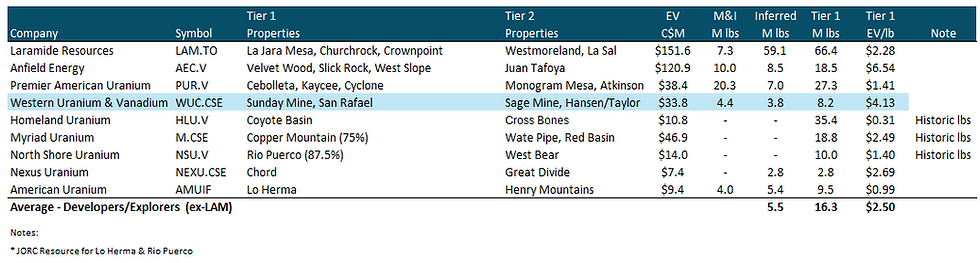
When compared to flagship projects from US focused, non-production peers, on an EV/lb basis, Western trades at one of the higher multiples, partly due to the relatively limited nature of the current SMC global resource of “just” 2.9M lbs. That said, Western comes out at the higher end of the valuation spectrum at $11.66/lb, a figure considerably higher than Laramide Resources’ Churchrock Project $2.98/lb, Permier American’s Cebolleta Project at $1.41 and American Uranium’s Lo Herma Project $0.99/lb (among others).

This high EV/lb metric is further seen when extending the resource to include all tier-1 projects. In Western’s case, tier-1 would include the Sunday Mine Complex along with San Rafael, thus increasing the resource (all categories) to 8.2M lbs. In any case, Western’s Tier-1 EV/lb of $4.13 still ranks near the top of the peer list which averages $2.50/lb (ex-LAM).

VALUATION & CONCLUSION
We continue to see Western Uranium & Vanadium as a company very much at the crossroads with plenty of ambitious plans on the horizon however in need of some concrete development milestones or strategic M&A in the near term. These concrete development plans include actual economic projections for the proposed Maverick (or Mustang) CPP, a possible PEA and some concrete resource growth at the SMC. We continue to believe that the initiative to build the proposed Maverick CPP (or Mustang CPP) is completely unjustified given the lack of sufficient resource needed to provide LT feedstock. We also believe that though not publicly announced, plans for the Maverick CPP may have already been shelved. A large scale drilling program across the SMC or San Rafael would be a much better, longer term use of capital. Conducting exploration and expanding the current resource will be paramount before attempting to undertake any large scale capital project such as the construction of a CPP. We also believe that something as basic as corporate communication needs to improved, for a publicly listed company, we find that much of what the company is very opaque and accompanied with insufficient press releases.
Factoring in the other assets along with current corporate adjustments, we maintain our target NAV multiple of 0.35x which leads to a $5.50 per lb driven, in-situ based price objective of C$0.55 per share (rounded). This equates to modest upside of +4% from the most recent close (July 7). Shares of Western Uranium & Vanadium currently trade at a 0.36x NAV multiple. We think that shares are currently fairly valued.


