Nexus Uranium Corp: Financing Closed; Chord Permitting Reaching the Finish Line

DISCLAIMER: Any written content contained herein should be viewed strictly as analysis & opinion and not in any way as investment advice. Visitors to this site are encouraged to conduct their own due diligence. As a Research Spotlight product, HoldCo Markets has received financial compensation for the written content and analysis below. Please read the full disclaimer here: holdcomarkets.com/disclaimer
We are initiating coverage of Nexus Uranium Corp. (NEXU) and establishing a C$0.90 per share, 12-month price objective. Over the last ~18 months, management has successfully re-positioned the company, exiting projects from the Athabasca Basin and acquiring strategic projects in the U.S. instead. Anchored by the flagship Chord Project which is strategically located next to enCore Energy’s (EU) Dewey Burdock Project, given an established current Inferred resource estimate, the stage is well set for the Chord’s further development. With a financing closed earlier this week, the pathway is well defined to de-risk and develop the flagship Chord Uranium Project.
COMPANY OVERVIEW
The company was originally incorporated under the Business Corporations Act (British Columbia) on May 31, 2017. A name change to Nexus Uranium Corp. was made effective on November 27, 2023 (previously, 66 Resources Corp and Golden Independence Mining Corp). Shares of the company currently trade on the Canadian Securities Exchange (CSE) under the symbol NEXU, on the OTCQB under the symbol NEXUF and on the Frankfurt Stock Exchange (FSE) under the symbol JA7. The company’s principal office is located in Vancouver.
Nexus Uranium’s principal business activities include the acquisition and exploration of mineral property assets. The company’s newly formed U.S. uranium portfolio includes the flagship Chord Property along with the Wolf Canyon, Deadhorse and RC projects, all located South Dakota. Other portfolio projects include 785 hectares in the Arizona Strip, located in Arizona’s Mohave County, along with the South Pass and Great Divide Basin projects located in Wyoming. The company also holds the Mann Lake uranium project in the Athabasca Basin of northern Saskatchewan, Canada.

THE NEW NEXUS URANIUM: SWAPPING THE A-BASIN FOR STRATEGIC US ASSETS
Nexus Uranium has drastically transformed its uranium portfolio when the merger with Basin Uranium was announced on June 26, 2025 and subsequently closed on September 16, 2025 when the flagship Chord project was brought into the fold. What has gradually happened since the merger was a concerted effort to re-position the company to highlight US-based assets while divesting from most of the previously held, Athabasca Basin assets. Key portfolio assets are now all in South Dakota – Chord, Wolf Canyon and RC/Deadhorse (all contained within a ~12 mile radius). Optionality in the Arizona Strip and to a lesser extent in Wyoming has been added or maintained in the portfolio. The company’s transformation over the last ~18 months can be summed up with the following key additions and subtractions from the overall project portfolio:
June 26, 2025: Announced merger with Basin Uranium (acquiring the flagship Chord Project in South Dakota)
September 24, 2025: Termination of Cree East (Athabasca Basin) Option Agreement (now 100% owned by CanAlaska).
December 8, 2025: Optioned the Great Divide Basin Project in Wyoming (optioned up to 90% to Canamera Energy Metals).
December 15, 2025: Sold 100% of the Wray Mesa Uranium Project in Utah to a private company.
January 15, 2026: Announced acquisition of Deadhorse Uranium claims in South Dakota.
March 19, 2026: Announced acquisition of the Breccia Pipe targets in the Arizona Strip.

Anchored by the resource-stage Chord Project, Nexus Uranium’s revamped, U.S.-focused portfolio now comprises six projects that are all potentially amenable to in-situ recovery (ISR) recovery techniques. These six projects are located in close proximity in South Dakota (Chord, Wolf Canyon, RC and Deadhorse) or Wyoming (South Pass and Great Divide). The Arizona Strip projects represent a unique high-grade uranium context within an area with significant historical exploration and endowment as estimated by the U.S. Geological Survey.
CHORD – SOUTH DAKOTA
Located on the southern end of the Black Hills, in Fall River County, South Dakota, the flagship Chord Project encompasses 147 continuous lode mining claims totaling ~3,640 acres. Specifically, the Project is situated in Edgemont, South Dakota and is approximately 5 miles southeast from enCore Energy’s (EU, Target C$2.75 per share) Dewey Burdock development Project which currently hosts a total U3O8 resource of nearly 18M lbs.

According to the 2025 updated NI43-101 compliant Technical Report prepared for Nexus Uranium by BRS Engineering, mineralization at Chord is sandstone-hosted, and channel-bound into tabular and lenticular deposits within the Lakota and Fall River Formations of the Inyan Kara Group. The Inyan Kara group is between 225 and 700ft in total thickness and is split into two main formations, the Lakota and the Fall River. Both the Fall River and the Lakota contain local coal and carbonaceous units and both host uranium mineralization. The uranium mineralization in the Fall River and Lakota formations is widely interpreted as roll-front in character. The shallower deposits dominate the Fall River formation and are typically oxidized consisting of carnotite and tyuyamunite. The current geologic and resource model reflects three sand horizons (A, B and C) over the stratigraphic thickness of approximately 400ft in the Inyan Kara Group.
Within the Inyan Kara group, it is believed that the shallow, uppermost deposit (A Horizon) is found within the Fall River Sandstone. The upper Lakota Fuson member is made up of primarily shales and mudstone with localized limestone and sandstone deposits and exhibits no substantial uranium mineralization. It is interpreted that the lower 2 horizons (the B Horizon and C Horizon) are found in the lowest member of the Lakota formation, The Chilson. The minerals are found largely in sandstones and associated with pyrite, marcasite, calcites, and carbon. The sandstone hosts are widely stained yellow by limonite oxidation, and this staining has been noted to obscure the redox boundary. In some areas of the deposit, it has been noted that a change from limonite to hematite staining can be a marker of the redox boundary.

The depositional character of the Chord Uranium Project is that of a sandstone hosted roll front. The ore deposit is contained in fluvial channel sandstone deposits within the early Cretaceous Inyan Kara group. Regionally the Inyan Kara Group is bounded on top by the Skull Creek Shale and the bottom by a gray shale of the upper Morrison Formation.
Ownership & Exploration
Between the 1950s-1975, small deposit mining was taking place with some uranium recovered from the shallower deposits by small open pit mining methods. The mined material was processed through a conventional mill in Edgemont, South Dakota. Between 1974-1984, Union Carbide Corp (UCC) conducted extensive work on the property with programs ranging from exploration drilling, early mine development and work towards a Feasibility Study. UCC and others drilled over 2,000 drill holes on the Chord project. Project ownership changed hands numerous times between the mid 1980s-2021 when Cowboy Exploration and Development LLC took ownership of the Project and began claim staking. In 2023 Basin Uranium entered into an option agreement for a 90% interest in the Project from Cowboy Exploration. Basin subsequently completed a NI43-101 Technical Report for the Project (dated May 7, 2024), based on historic data. A 2.75M lb Inferred U3O8 resource was estimated. As mentioned, Nexus’ merger with Basin uranium was announced on June 26, 2025 and subsequently closed on September 16,2025. Shortly after, Nexus updated the Technical Report with a report dated September 19, 2025. The Chord Project was fully 100% consolidated by Nexus in a transaction announced on January 21, 2026.
Chord Resource Estimate
As part of the 2,000 historic holes drilled on Chord (mostly) by UCC, in preparation for the May 7, 2024 Mineral Resource Estimate, BRS Engineering had access to original data for a subset of 1,247 drill holes. Of that total, 431 drill holes totaling 212,000ft (encompassing 956 intercepts meeting the 0.02% cutoff) had both reliable collar mapping and geophysical data to form the basis for BRS to calculate a resource estimate. The Inferred resource was estimated by horizon, based on geologic interpretation and correlation. Mineral resources were estimated from three resource areas contained on the Chord Project – October-Jinx, Viking and Ridge Runner.

The Inferred resource estimate was conducted at a minimum grade of 0.02% eU3O8 and minimum GT of 0.25. As seen above, corresponding sensitivities were also calculated based on GT cutoff. The specific resource areas on the Project include the Ridge Runner area (being the shallowest of the areas with mineralization contained in the oxidized A horizon in the Fall River formation), the Viking area (containing deposits in both the B and C horizons of the Chilson formation) and finally, the October-Jinx area (containing deposits in both the B and C horizons of the Chilson formation). Given 232 total drill holes, the majority of the current Inferred resource is found within the October-Jinx claim area.
Exploration Target
The Technical Report concluded that Inferred mineralized resource areas have a reasonable possibility of connectivity between them along trends within the same fluvial sands of the Inyan Kara group. These broad trends have been projected to connect the drilling in the Viking Area to the Ridge Runner, the Ridge Runner to the October-Jinx, and Southwest of October Jinx.

As seen above, the estimated low range scenario is based on the sand horizon with the lowest average grade for the 0.1 GT cutoff. In this case it was based on the average grade for the A horizon at the 0.1 GT cutoff. The calculated estimate value for the low range scenario was 0.258 lbs of uranium per square foot.
The high range scenario is based on the sand horizon with the highest average grade for the 0.1 GT cutoff. In this case it was based on the average grade for the C horizon at the 0.1 GT cutoff. The calculated estimate value for the high range scenario was 0.768 lbs of uranium per square foot. The areas of the exploration target (being areas lacking in drill hole coverage between the Inferred resource areas) are the same areas for both the low range and high scenarios.

Historical Processing and Metallurgical Studies
Union Carbide Corporation conducted hydrometallurgical testing as part of their Phase II studies in 1980, for both underground and open pit mining development plans. The oxidized near to surface material was tested comprehensively and was determined to be an excellent candidate for heap leaching as a result of its high permeability. Up to 80mm sized rock fragments, the oxidized material was found to have no issues with channeling or material segregation. By using 20lb sulfuric acid per ton of mineralized material, recovery rates upwards of 90% U3O8 were achieved. The resulting liquor was 740 ppm U3O8; however, over 90% of the uranium extracted was in a concentration above 2g/L U3O8.
THE RC, DEADHORSE AND WOLF CANYON PROJECTS – SOUTH DAKOTA
The RC project comprises 40 unpatented lode mining claims totaling approximately 800 acres, located within 1.0 mile of the company’s flagship Chord uranium project in Fall River County, South Dakota. Located ~1.0mile to the south, the Deadhorse project comprises 17 unpatented lode mining claims totaling ~340 acres. Note that the Chord, RC and Deadhorse Projects are clustered in very close proximity to each other, with each project at most ~5miles form each other (as seen above in Exhibit 2). The RC Project was acquired this past January as a result of staking. The acquisition was announced shortly after it was announced that the Deadhorse Project was also acquired, via staking. Like with RC, the Deadhorse claims cover prospective ground within the same geological setting as the adjacent Chord project.
Just ~5miles further to the southeast of Deadhorse, the Wolf Canyon Project is comprised of 80 contiguous unpatented mineral lode claims totaling 1,600 acres. Similarly to Chord, Wolf Canyon was drilled extensively in the 1970s by Union Carbide.
ARIZONA STRIP - ARIZONA
This past March, Nexus announced that it had entered into a definitive agreement to acquire a 100% interest in the Arizona Strip Project, comprising 38 federal Bureau of Land Management (BLM) lode mining claims covering seven collapse breccia pipe uranium targets in Mohave County, Arizona. Specifically, the claims are located in the Arizona Strip, a premier U.S. uranium district with historic production grades typically ranging from 0.42%- 1.08% U3O8. As part of the acquired claims, there are seven drill ready breccia pipe targets (seen below in Exhibit 7) identified from historic exploration. The particular targets are located ~25miles to the west from a cluster of other projects currently owned by Energy Fuels (UUUU) – namely Arizona 1, EZ Complex and Pinenut. The acquired claims have had prior ground geophysics (CSAMT, seismic reflection, and ground magnetics) and surface sampling identifying uranium and multi-element pathfinder anomalies. A particular EM target features a historic drill hole that intersected breccia at depth, confirming the presence of a collapse pipe system.

Given the recently closed financing, management has set aside $400,000 devoted to the Arizona Strip for a VTEM survey, further sampling activities and mapping activities on the project.
SOUTH PASS AND GREAT DIVIDE - WYOMING
Located at the margin of the prolific Great Divide Basin of Wyoming which is estimated to contain over 270M lbs of uranium, the South Pass Project encompasses 3,040 acres and has had extensive drilling in the 1980s by Rocky Mountain Energy Corp. Similarly, the Great Divide Project (2,080 acres, also located in the Great Divide Basin) has also benefitted from extensive drill programs in the 1970s. The Project adjoins Premier American Uranium’s (PUR, Target C$1.55 per share) Cyclone Project which currently hosts an exploration target ranging between 7.9M-12.6M lbs U3O8. In December 2025, the Great Divide Project was optioned to Canamera Energy Metals (EMET) whereby Canamera will fund $2.75M in exploration over 4 years, in addition to cash and share payments.
SATELLITE DEPOSIT TO ENCORE ENERGY’S DEWEY BURDOCK PROJECT ?
Of particular note is that enCore Energy’s Dewey Burdock is located just ~5 miles to the northwest of Chord. This is significant because the Dewey Burdock Project has been rapidly advancing through the federal permitting process and is seen as enCore Energy’s flagship development project. Boasting a global resource of nearly 18M lbs U3O8 (of which, 17.1M lbs contained in the Measured & Indicated category), the current Dewey Burdock resource is hosted within the same Lakota formation which hosts the Chord resource. With federal permitting recently completed, state permitting is expected to be complete by the end of 2027. That said, with plant engineering underway and BLM construction authorization in-hand, Dewey Burdock represents one of the larger uranium development projects advancing anywhere in the U.S.

With an effective date of October 8, 2024, enCore Energy published a relatively recent S-K 1300 Technical Report (prepared by SOLA Project Services) for the Dewey Burdock Project. The report highlighted a 28-year LOM operation (including a 2 year ramp-up) producing over 14M lbs U3O8 over LOM, all via ISR extraction. In terms of the current resource estimate, though using the very same 0.02% eU3O8 minimum grade to define mineralized intervals as seen with the Chord Technical Report, the Dewey Burdock and Alladin Project Technical Reports differed by using a GT cutoff of 0.20%ft U3O8 compared to the more stringent GT cutoff of 0.25%ft U3O8 as used in the Chord Technical Report. We also highlight the total number of historic drill holes drilled on each Project while also providing context (when available) as to the number of drill holes actually used in compilation of each Mineral Resource Estimate.

enCore Energy envisions constructing a Central Processing Plant (CPP) comprising Ion Exchange recovery trains and yellowcake processing facilities. The ISR operating parameters as outlined in the S-K 1300 report include average recovery flow rates of 20 gpm, maximum CPP flowrate of 2,400 gpm and maximum satellite flow rate of 1,600 gpm. The given parameters are expected to establish between 900,000-1.0M lbs of annual U3O8 production. As seen below in Exhibit 11, enCore’s Alladin Project located well north of Dewey Burdock was specifically listed in the technical report as a potential satellite deposit. Given Alladin’s current ~1.1M lb Indicated U3O8 resource, lack of recent development and ~80 mile distance from Dewy Burdock, its clear to see that a further developed and de-risked Chord Project would offer more current resources at a much closer distance (just ~5 miles) to act as a compelling potential satellite deposit to the Dewey Burdock CPP. Needless to say, once the required permits will be in hand, a high impact drilling campaign at Chord will be a significant value driver for the company.

CHORD PERMITTING
Permitting has been progressing at Chord with federal permitting getting close to concluding. A snag was hit on the state permitting front earlier this May as the hearing before the South Dakota Board of Minerals and Environment was unable to conclude within the scheduled 5-day session. The hearing was unable to conclude due to certain intervenors commencing separate proceeding in the United States District Court for the District of South Dakota (Case No. 5:26-cv-5068) against South Dakota state agencies and officials, including the Board of Minerals and Environment, seeking emergency injunctive relief to stay the hearing until additional Lakota-language interpretation and translation services are provided. Largely seen as a delaying tactic, note that the proceeding did not seek the denial of the permit application nor did it challenge the merits of the Chord Project or the proposed exploration program. The proceeding has since been thrown out by the court. Though the exercise did cause somewhat of a delay on the State permitting front, Nexus management believe nevertheless that the hearing will be able to resume/re-start early next year. On the US Forest Service land permitting front, management expects all to conclude in early 2027.

NORTH AMERICAN BASED PEER GROUP
Our North American uranium based peer group is populated with developers/explorers with projects located in New Mexico and Colorado, to Utah and Wyoming as well (among others). Most of the listed companies have projects which either current or historic resources. Much like the extensive work conducted by Union Carbide on the Chord Project, most of flagship projects listed below have also had extensive historic drilling in either the 1970s or 1980s. As such, many of the peer companies also have extensive drilling databases and drill logs.
Though all peer companies need to be looked at though a company specific lens, the exhibit below gives certain context relative to the estimated flagship resource project. Owing to Chord’s relatively small 2.75M lb Inferred resource, the company ranks on the higher end with respect to EV/lb valuation. Owing to strategic location and/or quality of resource estimate (or recency), not all resource lbs are worth the same however.


VALUATION
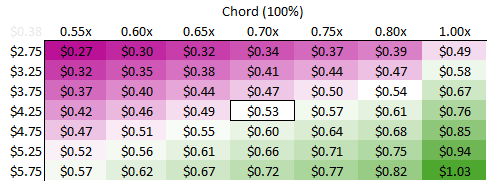
Owing to the recently estimated NI43-101 Inferred resource, we apply a $4.25/lb in-situ value to the current resource (as opposed to historic) estimated at Chord. Given Chord’s strategic location just ~5miles from enCore Energy’s rapidly advancing Dewey Burdock Project, we ascribe a target NAV multiple of 0.70x for the Project. Factoring in the other assets along with current corporate adjustments, we derive an in-situ based price objective (12-months) of C$0.90 per share (rounded). This equates to potential upside of +67% from the most recent close (September 21, 2026). Shares of Nexus Uranium currently trade at a 0.49x NAV multiple.

CONCLUSION
Nexus management has accomplished quite a bit over the last ~18 months in terms of divesting and/or dropping select previous projects (largely located in the Athabasca Basin) and re-positioning itself with a string of acquisitions in strategic locations in the U.S. Anchored by the flagship Chord Project, we feel that the risk is certainly on the upside for the continued de-risking and development of the Project. It is our belief that the permitting of Chord is a near term eventuality rather than a mere possibility. Once all permits will be in hand (expected by mid-2027), the next valuation lift will be via the drill bit given an impactful drilling program. The current resource and accompanying datapoints offer a solid starting point to commence the first drilling program since the 1970s. Close proximity to Dewey Burdock combined with enCore’s continued efforts to development the Project will act to also support Chord’s development. Now post-financing, with a cash balance in treasury equivalent to ~30% of mcap, the pathway is well defined for a valuation re-rate higher.
NEAR-TERM TIMELINE & POTENTIAL CATALYSTS
VTEM Program (Arizona Strip) - Q4/2026
U.S. Forest Service Land Permitting Board Meeting (Chord) – Q4/2026-Q1/2027
State Mineral Board Hearing (Chord) – Q1/2027

