Divergence Between Uranium Prices and Volumes: Our Thoughts and Favored Picks

DISCLAIMER: Any written content contained herein should be viewed strictly as analysis & opinion and not in any way as investment advice. Visitors to this site are encouraged to conduct their own due diligence. As a Research Spotlight product, HoldCo Markets has received financial compensation for the written content and analysis below. Please read the full disclaimer here: holdcomarkets.com/disclaimer
With just about two months left in the year, we highlight a very divergent current path between term uranium pricing and contracted volumes. While the term uranium price sits at a decade+ high, contracted volumes for 2026 (annualized and forecast) currently stand at a multi-year low. Our thoughts on the current dynamic are presented below, as is a highlight of our favored picks in the sector, namely - Terra Clean Energy (TCEC), Ur-Energy (URG), Myriad Uranium (M) and Nexus Uranium (NEXU).
TERM URANIUM PRICE AT A DECADE+ HIGH
Term uranium pricing has increased by +11% YTD to reach $96.50 per lb (as of September-end) representing the latest 10+ year high and increase of +290% since the January 2020, post-pandemic lows. Though more attention is seemingly placed on the spot price (itself +10.5% YTD), utilities predominantly transact at the term price, making it a much more reflective indicator of actual market action. The term price is essentially an indicator published by UxC or Tradetech, as a monthly assessment reflecting long-term contract transactions. These are specifically contract transactions executed at price levels that utilities and uranium producers agree to, for multi-year supply. The term differs from the spot in the sense that the spot can be seen as merely a reflection of near term, one-off transactions, reflective of the marginal price of uranium for near-term delivery.

The term price has historically traded at a premium to the spot price, seeing as utilities transact to secure future supply while producers require a price to incentivize production and investment. Though absolute contracting volumes clearly indicate increasing (or decreasing) utility activity to secure future supply, when assessing or analyzing utility procurement, term prices along with corresponding volumes must be viewed in tandem.
THOUGH TERM PRICE CONTRACTING IS WAY UP, CONTRACTING VOLUMES ARE WAY DOWN
While the term price has consistently marched higher, utility contracting has gone in the opposite direction, with the annualized 2026 amount expected to represent a 5 year low, even after factoring in year-end seasonality. At an estimated ~100M lbs for FY/2026 (or annualized at ~90M lbs), the expected term figure falls well below the ~130M lb trailing 3 year (2023-2025) average.
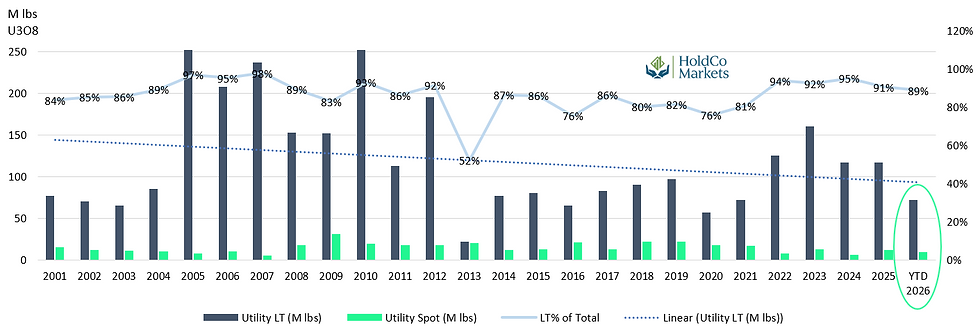
It is our opinion that the drop in utility contracting has very much to do with NexGen Energy’s (NXE) massive Rook I Uranium Project. With significant production expected to hit the market in mid-2030, there is strategic reason utilities to remain on the sidelines for the time being.
THE URANIUM SUPPLY-DEMAND WAITING GAME BEING SHAPED BY NEXGEN’S ROOK I
Following a 7-year permitting process, construction for the massive uranium operation has officially started this past August. After a multi-year build, the Rook I Project is expected to be one of the largest mining projects in the world and may add as much as ~20% of current mine supply once at production capacity in mid-2030e. It is our opinion that given this much significant supply hitting the market (up to ~30M lbs per year), utilities have reason to be patient with regards to contracting. Conversely, while waiting for higher prices, NexGen is in no rush to commit today to term contracting. Knowing that NexGen is unwilling to contract at present, utilities may be incentivized to delay purchases until closer to 2030 – thus the current contracting vacuum. Reducing the market’s perception of future uranium scarcity can delay utilities’ urgency to contract. On the flip side, it may also be possible that the highly touted 30M lb per year by ~2030 production figure is overly optimistic. The current Development progress at Rook I is depicted below:

THE CURRENT $90/LB SPOT PRICE REFLECTS THE CURRENT MARKET TIGHTNESS
Getting projects online and/or maintaining uranium production levels is complicated, as was seen over the course of this year with Peninsula Energy’s (PEN) Lance Project, enCore Energy’s (EU) Alta Mesa, and even with Cameco (CCJ) expansion plans. Moreover, delays and still unresolved investment decisions at Global Atomic (GLO), Boss Energy (BOE) and Deep Yellow (DYL) have seemingly become the norm. That said, we continue to estimate ~24M lbs in uranium production growth by 2030, implying a supply deficit growing by over ~5M lbs by then. That said, the post-2030 period will be critical if one s to fully ascribe to the nuclear renaissance thesis. With additional uranium demand expected to hit the market then from SMRs (namely Kairos, X-Energy, TerraPower-Oklo), it will become that more critical for NexGen to hit its production milestones from Rook I. Ramping Rook I to ~30M lbs per year will be the critical counterweight to what is seen as significant increase in demand by 2030.
CONCLUSION: OUR TOP IDEAS POSITIONED FOR THE 2026-2030 PERIOD
Our small/mid-cap investment ideology remains, we continue to favor two particular investment themes: 1) geographic projects or mines location in the North America and 2) a preference for development projects which have either an extensive history of past production and/or have an extensive history of past drilling, along with the accompanying technical reports and/or historic data. This is best exemplified by our favored ideas below:
Terra Clean Energy’s Marysvale Project (Utah) – Price objective C$0.22 per share
Ur-Energy’s Lost Creek Mine (Wyoming) - Price objective C$2.50 per share
Myriad Uranium’s Copper Mountain Project (Wyoming) – Price objective C$0.95 per share
Nexus Uranium’s Chord Project (South Dakota) – Price objective C$0.90 per share
TERRA CLEAN ENERGY CORP (TCEC): HIGH IMPACT DRILLING ABOUT TO BEGIN
Over the last ~12 months, Terra management has been active in re-shaping the company by spearheading a concerted effort to add strategic U.S. uranium projects in order to diversify from being solely an Athabasca Basin focused uranium company. With successful staking/acquisitions in Wyoming and two recent Utah earn-in agreements finalized, given the compelling re-focus of the company, we highlight the rapid development work conducted since on the wholly-owned Marysvale Uranium Mines Project, located just 115 miles from DISA Uranium’s Tony M Mine in Utah.

Since announcing the earn-in agreement for the Marysvale Uranium Mines Project this past January, Terra management has been focused on compiling historic data, initiating various work programs and pushing ahead with permitting in a very timely manner. Ahead of a highly anticipated drilling campaign, the publication of a NI43-101 compliant Technical Report (effective date of May 31, 2026) is the culmination of these efforts. That said, combined with the use of modern exploration techniques and 3D modeling, management will use the historic data gathered (drill results, geochemical results and sampling) to fine tune targets in the priority zones now identified on the property. Of note is that recently procured drill logs, geochemistry data, geologic data and maps will serve to further refine the upcoming drill targets.
The completed Technical Report represents a significant milestone in Terra’s systematic evaluation of the Marysvale Uranium Mines Project and provides a comprehensive review of the property’s geology, historical mining activities, exploration results, and future exploration potential. The Technical Report incorporates the company’s recently completed data compilation program, digitization of historical records, and interpretation of geological and structural information collected from the project area. This has been quick work seeing that the Project was acquired earlier this year. The Marysvale Uranium Mines Project includes several past-producing uranium mines within one of the most historically productive uranium districts in the western United States.
As announced earlier this month, due to strong investor demand, a targeted C$2.0M financing was upsized to C$2.4M and has since closed. The financing will provide the needed capital for both the upcoming drilling campaign at Marysvale (expected to commence very shortly) and for the initial environmental baseline study.
Drilling Expected to Commence in the Days Ahead
With a site preparation crew mobilized and drill pads being built, the planned 10,000ft core drilling campaign at the flagship Marysvale Uranium Mines Project is set to begin in late October/early November. The planned drilling campaign represents the first meaningful exploration campaign on site since the 1970s. The drill program will evaluate the resource potential surrounding the Prospector and Freedom Mines which historically accounted for 75% of the district’s 1.33M lbs U3O8 produced at an average grade of 0.22% U3O8.
KB Drilling Co. has been contracted to conduct the planned 10,000ft core drilling campaign at the Marysvale Uranium Mines Project. Specifically, the drilling campaign will evaluate the resource potential surrounding the Prospector and Freedom Mines. Drilling will be conducted from five permitted drill pads encompassing 12 drill targets. Though historical drilling focused on the accessible portions of the known vein systems, the same historical drilling indicates that mineralization continues more than 600ft below portions of the former underground workings. The specific objectives of the upcoming drilling campaign include:
• Test the down-dip continuation of mineralized veins beneath the former mine workings;
• Evaluate strike extensions beyond the historically mined areas;
• Confirm the location, orientation, width and grade of known mineralized structures;
• Identify parallel veins and previously unrecognized mineralized structures; and
• Generate geological and assay information to guide subsequent drilling and resource-evaluation work.
The mineralized structures remain open for testing along strike and at depth. The upcoming drilling program will incorporate historical drill logs, assay information, underground workings and mine maps, along with recently completed airborne radiometric, photogrammetric surveys and 3D geological models. Combining the historic data with the recently completed airborne radiometric surveys, photogrammetric surveys and 3D geological models, it is believed that substantial potential exists to expand the known mineralized footprint.
The Marysvale Uranium Mines Project
Terra’s 20 claims cover four past producing uranium mines (the Prospector 1 Mine, the Prospector 4 Mine, the Buddy Mine and the Lucky Strike Mine). Collectively, the Marysvale district produced over 1.33M lbs at a reported grade of 0.22% U3O8. It is estimated that 75% of that historic production (~1.0M lbs U3O8) came from the Prospector and Freedom mines, part of Terra’s Marysvale package. The Marysvale District hosts nearly vertical, northeast and east striking fissure veins that cut granitic and volcanic rocks of the Belknap volcanic sequence and is a prime example of an epithermal vein-style uranium system. Ore is located within the north-northwesterly striking, near vertical, Prospector Fault. Uranium in the area was discovered in 1948 and mining commenced in 1949 by Vanadium Corporation of America (VCA). Over the next few years they consolidated various claims and operations in the area. Production ceased in the Marysvale area in 1969. Some exploration drilling was undertaken in the area in the late 1970’s.
A Technical Report authored by the US Department of the Interior Geological Survey dated September 1950 specified that inclined shafts were sunk on the Prospector 1 and Freedom 2 claims. The first ore mined was trucked to Naturita, Colorado, for experimental processing. Subsequent ore was stockpiled near the mines with much being purchased by the American Smelting and Refining Company under the authority of the Atomic Energy Commission.
Recapping Our Investment Thesis
On an EV basis, Terra currently trades at a ~60% discount to its U.S.-focused, pre-resource peer group. We feel that this is currently justified given the constraints weighing on the company such as company size and liquidity. Moreover, the new direction positioned towards Utah and Wyoming coupled with the very modest and attainable earn-in conditions remain largely unknown to the market. It is our view that this dynamic will change as the new assets will slowly de-risk as development ramps and milestones are made.
Earn-In Agreements Signed for Utah Uranium Properties – Earlier in January Terra announced plans to earn a 100% interest in the past producing Freedom & Prospector Mines Project, located in Marysvale Utah. This announcement follows the September 2025 announcement that an earn-in framework was negotiated for a 100% interest in past producing uranium claims (the Wheel Anne claims and the Green Vein Mesa claims) located in Emery County, Utah.
Historic Production, Strategic Location – The Utah claim areas include a number of historic mines which collectively produced approximately 1.45M lbs uranium between 1949-1969. Both Utah claim areas are well situated within 300km of either the White Mesa mill or the Shootaring Canyon mill.
Successful Staking in Wyoming – Given low cost staking and lease acquisitions, a sizeable 3,395 acres were obtained in Wyoming. Located in the Washakie Basin, the property package is situated just 75km from historic uranium production in the Poison Basin and 120km from enCore Energy’s PEA-level Juniper Ridge Uranium project.
This is the New Terra Clean Energy Corp. – Though the uranium portfolio continues to contain the 6.8M lb deposit in the Athabasca Basin (South Falcon East), the recent US acquisitions fundamentally change the profile of the company. In our view, the new claim areas and the corresponding capital outlays which we deem as modest and achievable, greatly enhance the profile and future prospects of the company.
CONCLUSION & VALUATION
Though Terra’s uranium portfolio continues to be anchored by the 6.8M lb South Falcon East deposit (Athabasca Basin), the recent U.S. acquisitions have fundamentally changed the profile of the company. Since last Fall, Terra management was successful with identifying strategic uranium properties and then either staking or negotiating earn-in agreements at what we deem as a modest capital outlay with meaningful ownership milestones. The claims on past producing properties in Utah include valuable historic data compiled by the U.S. Geological Survey (among others). Combined with the use of modern exploration techniques and 3D modeling, management will use the historic data to identify priority targets for confirmation drilling in identified zones and exploration drilling to test for extensions. The completion of a NI43-101 compliant Technical Report is a culmination of all the efforts conducted thus far.
Given a revamped management team, a newly re-constituted Board and Terra’s recent initiatives into Utah and Wyoming, much new interest has been re-injected into the company. We note that the average trading volume YTD has nearly tripled the average daily figure from 2025. Ultimately, we look forward to the start of the high impact drilling program at the Marysvale Project. Underpinned by our $4.75 per lb in-situ valuation for 51% ownership of South Falcon East, our 0.60x NAV multiple leads to our C$0.22 per share price objective. This implies upside of +69% from the recent close (October 26).


UR-ENERGY (URE): THE VALUE PLAY WITH ISR PRODUCTION FROM BOTH LOST CREEK & SHIRLEY BASIN
Though ISR production began at Lost Creek back in 2013, this past August it was announced that production from a second ISR platform – Shirley Basin was nearing full operational capacity. With a licensed wellfield and toll processing capacity of up to 2.0M lbs of U3O8, Shirley Basin is also located in the ISR hotbed of Wyoming. Specifically, Shirley Basin is being run as a satellite mine of the company's Lost Creek hub operation.

As announced last August in conjunction with the Q2/2026 results, a record 140,873 lbs U3O8 was drummed at Lost Creek during the quarter and 105,016 lbs were captured as flow rates continued to improve as a sand filtration system was installed and brought online last month. Development of the wastewater treatment facility progressed in the quarter with the company breaking ground in July. Contingent on regulatory approval, the company expects to commence wellfield construction and installation in the fifth mine unit by year-end 2026, where 15 header houses are planned from late 2026 through 2028. At quarter-end, 17 drill rigs were actively supporting the Lost Creek drilling program - an increase of two from the previous quarter.
Expecting Even More from Shirley Basin in Q3
Last quarter management stated that Shirley Basin loaded resin has been transported to Lost Creek. Just as significantly, full production operations were achieved just two and a half years after the build-out decision. This has proven to be a quick ramp period given that initial extraction operations only began this past April. That said, while conducting only limited operations, the company succeeded in capturing 10,634 lbs of U3O8 at the Shirley Basin plant during the Q2/2026 period. Much more is expected in the coming Q3 quarter.
Recall that since the Shirley Basin ISR Project was initially acquired in 2013 (via the Pathfinder Mines acquisition), the announced ramp-up milestone marks Ur-Energy's second successful ISR mine brought online from early development. With a Measured & Indicated resource of 8.8M lbs U3O8, Shirley Basin's estimated LOM is 9 years (spread over three shallow mine units) while the plant has a capacity for 1.0M lbs per year.
Recapping Our Investment Thesis
As flow rates continue to improve at Lost Creek, Shirley Basin now at full capacity adds another functioning ISR operation to Ur-Energy's portfolio. With sales agreements for 5.75M extending from 2026-2033 (eight agreements, featuring a mix of escalated fixed pricing and market-related pricing with floors and ceilings), the addition of a second meaningful operating mine will provide the company with the flexibility needed for delivery and for the potential signing of additional LT contracts.
LT Uranium Delivery Contracts: We will see if any new contracts have been signed with utilities once the Q3/2026 results are announced however as of today, the contract book is extensive – current sales agreements are in place for 5.75M lbs extending from 2026-2033. These current contracts encompass eight agreements, featuring a mix of escalated fixed pricing and market-related pricing with floors and ceilings.
Diversified Production Base: Shirley Basin reaching full operational capacity adds another functioning ISR operation to Ur-Energy's portfolio. The addition of a second meaningful operating mine site will provide the company with the flexibility needed for delivery and will aid with the signing of additional contracting. We expect production to increase in the upcoming quarter as flowrates continue to improve at both sites.
Solid Treasury: In addition to the ~350,000 lbs of U3O8 held in inventory the company held nearly $100M in treasury (as of Q2/2026). Cash and equivalents in treasury amount to a meterial ~20% of current mcap.
CONCLUSION & VALUATION
While maintaining our $100 per lb LT uranium price, we also maintain our 1.3x NAV8% valuation methodology. As such, our 12-month price objective is maintained at $2.50 per share (rounded) representing 114% upside from the recent October 26 close. Given a ~27% share price decline over the last month, shares of Ur-Energy currently trade at a 0.64x NAV multiple. Q3/2026 results will be disclosed in mid-November.


MYRIAD URANIUM (M): COPPER MOUNTAIN - THE NEXT LARGE SCALE US URANIUM DEPOSIT ?
As started in July, Myriad’s Phase 2 drilling program at the Copper Mountain Uranium Project (Wyoming) is in full swing with a total of 4,500m of drilling planned for, over two stages. Stage 1 of the current drilling campaign will test areas of mineralization underlying the historical estimates. A total of ~2,250m is expected to include drill holes on the Lucky Cliff, Arrowhead, Mint, Hesitation and Gem targets. A further ~2,250m will be earmarked for Stage 2 step-out drilling on priority targets previously identified by the Union Pacific and Bendix technical studies. Certain new targets which were not part of any historic resource estimate or any historic resource exploration target will also be drilled as part of stage 2. Contingent on positive stage 1 and 2 drilling, a final stage 3 drilling campaign will be undertaken. This final stage 3 is expected to encompass between 2,400m-5,500m of infill drilling to support a maiden mineral resource estimate by bringing some of the historic resource into current categories.

Following a maiden drill program which concluded in late 2024 (the first of any such drilling campaign conducted at Copper Mountain since 1979), Myriad management remains busy in the midst of Phase 2 drilling and in the midst of completing a 100% consolidation of the Copper Mountain Project (a Rush shareholder vote is scheduled for August 17). Building upon an extensive database comprising of over 2,000 boreholes and encompassing a combined ~900,000+ feet of historic drilling, Myriad is in the midst of its confirmation/exploration drilling program with the intent to bring the historic Copper Mountain resource to current-day NI43-101 compliance. Studies conducted between the late 1970s-early 1980s have estimated the resource to be between 15.7M-30.1M lbs U3O8. Other estimates have suggested resource potential upwards of several hundred million lbs U3O8. Since a maiden drill program was conducted in 2024, Myriad has much riding on the current Phase 2 program. We expect the Project to continue to de-risk while an eventual NI43-101 compliant resource may have the potential to officially rank Copper Mountain as one of the larger uranium deposits located in the United States.
Recapping Our Investment Thesis
What gives Myriad a big head start with regards to developing Copper Mountain is the substantial project de risking already achieved by way of its historic drilling program. This historic drilling program (conducted in the late 1970s) provided a vast array of technical data which lead to numerous technical reports and various resource estimates derived from different methodologies. In short, the substantial historic work conducted on the Copper Mountain Project has amounted to: A) C$117M in historic exploration spent (2024 dollars), B) 2,000+ historic boreholes drilled on the property (totaling ~900,000+ ft), C) A total of 7 deposits discovered and D) Numerous technical reports & resource estimates. In addition to the historic work completed on site, other company positives include:
Location: Wyoming is known to host the large uranium reserves in the United States. The state’s tier-1 uranium status is also accentuated by the fact that nearly a dozen uranium operations are currently licensed. Moreover, uranium mining is currently being conducted at four separate facilities: Ross CPP, Smith-Ranch highland, Nichols Ranch and Lost Creek. Lastly, Wyoming is home to one of the largest uranium mills in the US – currently on standby, the Sweetwater mill has a capacity for 3,000 tpd.
Recent Drill Program Success: Myriad’s Phase 1 drill program returned better than expected grades when using spectral gamma detection. With regards to the recently started Phase 2 drilling campaign, results from seven drill holes (cumulative 1,224m) have already been released from drilling at both the Gem and Lucky Cliff targets. Results from drilling at the Arrowhead, Mint and Hesitation targets are upcoming. We note that the recent probe results from Gem have surpassed earlier results from Lucky Cliff.
On the Path to Complete a NI43-101 MRE: Provided a successful stage 1, 2 and 3, the basis for a milestone NI43-101 compliant Copper Mountain resource estimate will be established. Given the mix of infill and step-out targets in brand new areas, the potential exists to both increase the size and the prospectivity of the overall deposit. Recall that 100% ownership of the Copper Mountain Project was finalized with the acquisition of Rush Rare Metals this past August.
CONCLUSION & VALUATION
The on-going Phase II drilling campaign follows up from the successful 34-hole, Phase I campaign which concluded in late 2024 and focused on the Canning deposit. Given the initial results from the Phase 2 campaign, as probe results from drilling has vectored closer to the Canning deposit (going from Lucky Cliff to Gem), peak eU3O8 grades and lengths have correspondingly increased. We look forward to the probe results from the Arrowhead, Mint and Hesitation targets as well and note that like Gem, these targets are all within the historic Control Area.
Provided a successful stage 1, 2 and 3, the basis for a milestone NI43-101 compliant Copper Mountain resource estimate will be established. Given the mix of infill and step-out targets in brand new areas, the potential exists to both increase the size and the prospectivity of the overall deposit. The completion of a NI43-101 compliant resource estimate for Copper Mountain may rank the Project as one of the largest located anywhere in the U.S. We maintain our 0.65x NAV-derived, C$0.95 per share price objective (rounded) which equates to upside of +183% from the most recent close on October 26. Shares of Myriad Uranium currently trade at a 0.24x NAV multiple.


NEXUS URANIUM (NEXU): CHORD PERMITTING REACHING THE FINISH LINE
Last week we initiated coverage of Nexus Uranium Corp. and established a C$0.90 per share, 12-month price objective. Over the last ~18 months, management has successfully re positioned the company, exiting projects from the Athabasca Basin and acquiring strategic Projects in the U.S. instead. With a financing closed earlier this week, the pathway is well defined to de-risk and develop the flagship Chord Uranium Project. Located in Edgemont, South Dakota, the wholly-owned, Chord Project has benefited from ~2,000 historic holes drilled on the Project in the 1970s by Union Carbide. Given the publication of a 2024 NI43-101 Technical Report, Chord’s Inferred resource (based on historic drilling) was estimated at 2.75M lbs with an exploration target between 1.42M-4.23M lbs.

Chord is located just ~5 miles to the southeast of enCore Energy’s (EU) Dewey Burdock ISR Project which currently hosts a total U3O8 resource of nearly 18M lbs. With permitting well advanced and engineering plans already in the works, enCore Energy envisions constructing a Central Processing Plant (CPP) comprising Ion Exchange recovery trains and yellowcake processing facilities capable of producing ~1.0m lbs U3O8 per year over a 20 year+ LOM.

Chord Exploration Target
An updated 2025 Technical Report concluded that Inferred mineralized resource areas have a reasonable possibility of connectivity between them along trends within the same fluvial sands of the Inyan Kara group. These broad trends have been projected to connect the drilling in the Viking Area to the Ridge Runner, the Ridge Runner to the October-Jinx, and Southwest of October Jinx. As seen above, the estimated low range scenario is based on the sand horizon with the lowest average grade for the 0.1 GT cutoff. In this case it was based on the average grade for the A horizon at the 0.1 GT cutoff. The calculated estimate value for the low range scenario was 0.258 lbs of uranium per square foot. The high range scenario is based on the sand horizon with the highest average grade for the 0.1 GT cutoff. In this case it was based on the average grade for the C horizon at the 0.1 GT cutoff. The calculated estimate value for the high range scenario was 0.768 lbs of uranium per square foot. The areas of the exploration target (being areas lacking in drill hole coverage between the Inferred resource areas) are the same areas for both the low range and high scenarios.

Recapping Our Investment Thesis
Nexus management has accomplished quite a bit over the last ~18 months in terms of divesting and/or dropping select previous projects (largely located in the Athabasca Basin) and re-positioning itself with a string of acquisitions in strategic locations in the U.S. Anchored by the flagship Chord Project, we feel that the risk is certainly on the upside for the continued de-risking and development of the Project. It is our belief that the permitting of Chord is a near term eventuality rather than a mere possibility. Once all permits will be in hand (expected by mid-2027), the next valuation lift will be via the drill bit given an impactful drilling program. The current resource and accompanying datapoints offer a solid starting point to commence the first drilling program since the 1970s. Close proximity to Dewey Burdock combined with enCore’s continued efforts to development the Project will act to also support Chord’s development. Now post-financing, with a cash balance in treasury equivalent to ~30% of mcap, the pathway is well defined for a valuation re-rate higher.
Established Resource With Plenty of Historic Drilling & Data: Wyoming is known to host the large uranium reserves in the United States. The state’s tier-1 uranium status is also accentuated by the fact that nearly a dozen uranium operations are currently licensed. Moreover, uranium mining is currently being conducted at four separate facilities: Ross CPP, Smith-Ranch highland, Nichols Ranch and Lost Creek. Lastly, Wyoming is home to one of the largest uranium mills in the US – currently on standby, the Sweetwater mill has a capacity for 3,000 tpd.
Situated Next to enCore Energy’s Dewey Burdock Project: Chord is located just ~5 miles to the southeast of enCore Energy’s Dewey Burdock ISR Project which currently hosts a total U3O8 resource of nearly 18M lbs. With permitting well advanced and engineering plans already in the works, enCore Energy envisions constructing a Central Processing Plant (CPP) comprising Ion Exchange recovery trains and yellowcake processing facilities capable of producing ~1.0m lbs U3O8 per year over a 20 year+ LOM. We would venture to assume that Chord has the potential to be developed to serve as a satellite ISR deposit once the CPP is constructed.
Chord Permitting Overhand to Lift: Now with a financing recently completed, U.S. Forest Service permitting is expected to be completed by the end of this year or in early 2027. On the State permitting front, hearings will re-start early next year.
CONCLUSION & VALUATION
Now post-financing, with a cash balance in treasury equivalent to ~30% of mcap, the pathway is well defined for a valuation re-rate higher. Anchored by a $4.25 per lb in-situ valuation combined with a 0.70x target NAV, we establish a C$0.90 per share price objective. This equates to upside of +64% from the most recent October 26 close. Shares of nexus Uranium currently trade at a 0.50x P/ NAV multiple. For more, refer to our October 22, 2026 initiation of coverage report.


EXHIBIT 1 – PEER VALUATION


